Page 2 - Kimberly Davenport
Kimberly Davenport
Author
Kimberly Davenport grew up in the suburbs of Salt Lake City, Utah. She earned a Bachelor’s Degree in English from the University of Utah. From there, she jumped into journalism, writing government and community publication articles. Kimberly enjoys the outdoors and tries to get to the mountains as much as possible to hike and enjoy peace and serenity with the fresh mountain air.
Today, Kimberly is a copywriter at Vitality Medical, writing product content and medical blogs. She currently resides in Richland, Washington. She lives near the Columbia and Yakima Rivers, making it easy to soak up the sun and enjoy a day paddleboarding and nature walks.
-
TLDR: Mouse droppings should be sprayed until very wet with a bleach solution or an EPA-registered disinfectant before cleanup. Dry sweeping or vacuuming should be avoided because it can move contaminated particles into the air. The safest approach is to ventilate closed spaces, wear a mask and gloves, wet the droppings first, wait for the correct contact time, wipe up the material with paper towels, bag the waste, and clean nearby hard surfaces.
Mouse droppings in a garage, shed, cabin, basement....
Read more »
-
TLDR: Most supplies for peptide injections are simple to keep together: syringes, needles if needed, alcohol swabs, gauze or bandages, a sharps container, and optional storage or travel items. Keeping these basics in one place makes them easier to find, check, and reorder.
For GLP-1, GLP-2, semaglutide, tirzepatide, or other peptide-related supply orders, the product listing should make it clear whether the needle is attached or purchased separately.
What Supplies Are Needed for Peptide Injections....
Read more »
-
TLDR: Peptide syringe sizes describe barrel capacity, such as 0.3 mL, 0.5 mL, or 1 mL. Needle size usually refers to gauge and length, such as 29G, 30G, 31G, 5/16 inch, or 1/2 inch. U-100 markings help compare syringe listings, but are not the same as the medication dose.
Peptide Syringe And Needle Sizes Explained: mL, Gauge, And Needle Length
The sizes can be confusing because product listings often combine several details within that syringe name. For example, a syringe may be listed as 1 mL, 30G....
Read more »
-
TLDR: GLP-1, GLP-2, and peptide-related therapies may require small-volume syringes with clear markings, commonly known as U-100 insulin syringes or compatible Luer lock syringes when medication requires a detachable needle. The main details to check are medication format, syringe capacity, unit markings, needle attachment style, gauge, and needle length. This guide explains syringe types and buying considerations only. It does not provide dosing, reconstitution, or injection instructions.
What Syringes....
Read more »
-
TLDR: Hidden medical supply costs often come from avoidable waste, inconsistent ordering, rush shipping, and staff time spent fixing purchasing problems. Private practices can protect margins by standardizing common-use items, tightening reorder habits, and working with a supplier that supports more consistent purchasing.
Hidden medical supply costs often come from quiet purchasing waste, not just higher prices. Many private practices lose margin through duplicate products, rushed reorders, expired....
Read more »
-
TL;DR
Low air loss and alternating pressure mattresses are often compared because both are used when a standard foam surface may no longer be enough. They are related, but they do not solve the same problem in the same way. Alternating pressure mainly changes support across the surface over time to help with pressure redistribution. Low air loss adds airflow to help manage heat and moisture at the sleep surface.
The better option depends on the real homecare problem. If pressure is the main concern....
Read more »
-
TL;DR
An alternating pressure mattress can be a strong option for home use when pressure relief becomes more important than basic comfort alone. It changes support across the surface over time, which may help when a person spends longer hours in bed, has limited mobility, or needs more than a standard foam mattress can provide.
The tradeoffs matter too. Pump noise, motion during sleep, setup, power dependence, and cost can make an alternating pressure mattress feel like more than some households....
Read more »
-
TL;DR
A mattress topper is usually the better fit when the goal is to soften the surface or make a lighter comfort adjustment while the underlying mattress still performs well. A replacement mattress usually makes more sense when the bed is used daily, the mattress feels worn or flattened, transfers are harder, moisture is a concern, or pressure relief needs have increased.
A topper changes the top layer. A replacement mattress changes the full support surface. The right choice depends on whether....
Read more »
-
TL;DR
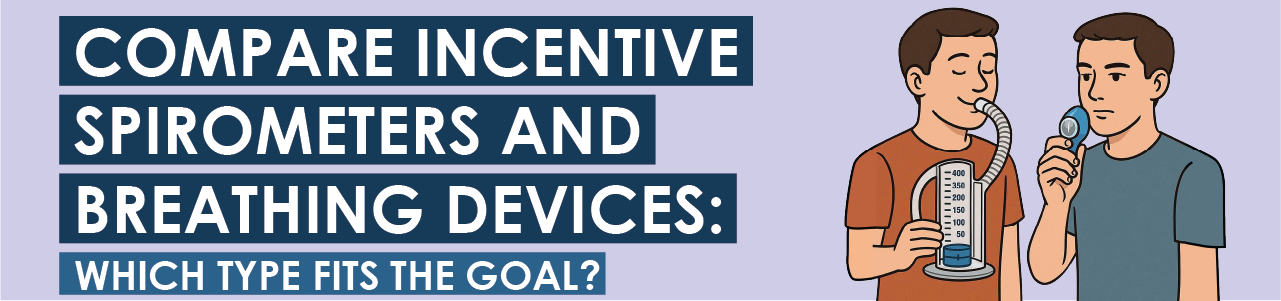
Not every breathing device is solving the same problem. Standard volumetric incentive spirometers fit basic post-op lung expansion and guided deep breathing.
Inspiratory exerciser formats can offer a different visual-feedback style. Respiratory muscle trainers are built for a different training goal than basic post-op spirometer use.
Spirometry systems fit testing and measurement, not simple home recovery breathing support.
Not every breathing device is built for the same use. Some products....
Read more »
-
TL;DR
Deep breathing after surgery matters and can be performed with or without a device. An incentive spirometer adds visual feedback and measurable targets.
That feedback can make guided breathing easier to repeat for some users. Not every product on the category page serves the same purpose.
Standard post-op lung expansion and respiratory muscle training are different use cases.
If deep breathing is already part of recovery, what does the incentive spirometer actually add? Many patients are told....
Read more »









Login and Registration Form