TL;DR
Deep breathing after surgery matters and can be performed with or without a device. An incentive spirometer adds visual feedback and measurable targets.
That feedback can make guided breathing easier to repeat for some users. Not every product on the category page serves the same purpose.
Standard post-op lung expansion and respiratory muscle training are different use cases.
If deep breathing is already part of recovery, what does the incentive spirometer actually add? Many patients are told to take deep breaths after surgery, whether they use a device or not, so it is natural to wonder whether the spirometer changes anything or just complicates the breathing exercise. The key difference is that the device adds visual feedback and measurable targets, which can matter more for some users than unstructured deep breathing alone. This is also the strongest decision-point article in the series because the category includes both standard post-op incentive spirometers and respiratory muscle training products that are not the same purchase.
Jump To A Section
- What Deep Breathing After Surgery Is Trying to Do
- What an Incentive Spirometer Adds
- When the Device May Help More Than Unguided Deep Breathing
- What People Often Get Wrong About the Comparison
- How to Choose the Right Device for This Problem
- Products to Feature
- Final Takeaway
What Deep Breathing After Surgery Is Trying to Do
Deep breathing is used after surgery to help keep the lungs active. It supports lung expansion during a time when pain, bed rest, and anesthesia effects can lead to shallow breathing. The basic goal is to keep air moving through the lungs and reduce the chance of postoperative breathing problems. That goal exists no matter if the patient is using a spirometer device.
What Deep Breathing Is Trying to Support:
- Fuller breaths
- More lung expansion
- Better air movement
- Less time spent breathing shallowly
That is why deep breathing gets emphasized so often in recovery. The point is not just to take a nice breath. The point is to keep the lungs more active at a time when the body is naturally drifting toward shorter, weaker breathing patterns.
What an Incentive Spirometer Adds
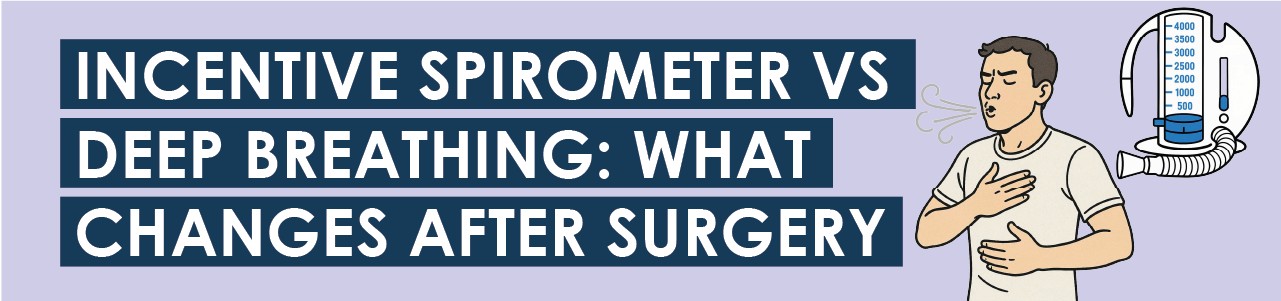
An incentive spirometer turns deep breathing into a guided exercise. Instead of asking the patient to just remember to inhale deeply, it gives visual feedback while the patient inhales. That can include volume markings, piston movement, or goal indicators that make the breathing effort easier to see and repeat.
That structure matters because it can make the exercise feel more concrete. A person is not just trying to breathe deeply. A person is following a visible target and getting feedback about how the breath is going.
| Approach | What the User Gets | What May Be Harder Without Guidance |
|---|---|---|
| Deep Breathing Without a Device | A simple breathing exercise that can still help support lung expansion | It can be harder to judge effort, consistency, and progress |
| Incentive Spirometer | Visual feedback and measurable targets during inhalation | The structure may still feel repetitive, but it is easier to repeat with guidance |
When the Device May Help More Than Unguided Deep Breathing
Some patients do fine with verbal guidance and repeated deep breathing alone. Others are more likely to stay consistent when they can see a target. For users who feel discouraged, confused, or inconsistent, the spirometer can make breathing practice feel more concrete and repeatable at home.
This does not mean the device automatically makes recovery better for every person. It means some users respond better to structure, visual feedback, and a measurable routine than they do to unguided breathing practice alone.
Who May Benefit More From Device-Guided Breathing:
- Patients who want a visual target
- Users who need more structure
- People who want a measurable routine
- Patients who are more likely to follow through when they can see progress
What People Often Get Wrong About the Comparison
Some people assume the device is just replacing ordinary deep breathing. Others assume the device is automatically better in every situation. Many also do not realize that standard post-op incentive spirometers are different from respiratory muscle trainers.
The biggest mistake is treating all breathing devices as if they do the same job. They do not. Standard incentive spirometers, respiratory muscle trainers, and spirometry systems belong to different device classes with different goals.
Common Misunderstandings:
- Deep breathing and the spirometer are completely different exercises
- Any breathing device will work the same way after surgery
- Respiratory muscle trainers are the same as standard post-op incentive spirometers
- The category page is one single device class when it actually contains several
How to Choose the Right Device for This Problem
The right choice depends on the actual recovery goal, not just on whether the product is listed in the same category. Some devices are meant for standard post-op lung expansion. Others are designed for guided breathing practice, muscle training, or clinical testing. Keeping those use cases separated helps prevent bad product matching.
| Device / Category | Best Intended Use | Best For | Not Ideal When |
|---|---|---|---|
| AirLife Volumetric Incentive Spirometer | Standard post-op lung expansion | Users who want adjustable goal indicators and flexible tubing | The goal is respiratory muscle training instead of basic post-op recovery |
| Medline Voldyne Volumetric Incentive Spirometer | Standard guided deep breathing after surgery | Users who want a classic volumetric design and visual flow indicators | The user is shopping for a trainer or diagnostic spirometry system |
| Coach 2 Incentive Spirometer | Basic repeat home use after surgery | Users who want a straightforward recovery device | The goal is advanced inspiratory or expiratory muscle training |
| McKesson LUMEON Volumetric Incentive Spirometers | Standard post-op incentive use with volumetric options | Users comparing different capacity options for guided breathing | The user needs a training device or a clinical measurement system |
| EMST150, EMST75 Lite, The Breather, Threshold IMT | Respiratory muscle training | Users training inspiratory or expiratory muscle strength | The need is a simple standard post-op incentive spirometer |
| Spirometry Systems | Testing and measuring lung function | Clinical measurement and pulmonary testing use cases | The user needs a simple recovery breathing device for home |
Best for Standard Post-Op Lung Expansion
This bucket fits users who need guided deep breathing after surgery. Standard volumetric incentive spirometers belong here. This is the right category for basic post-op breathing support when the main goal is lung expansion and guided inhalation practice.
Best for Repeat Daily Guided Breathing Practice
This bucket fits users who need strong visual feedback and easy routine use. Standard incentive spirometers with readable markings and simple targets fit best here. This is where product design, readability, and ease of handling start to matter more.
Not the Same Thing: Respiratory Muscle Trainers and Spirometry Systems
EMST150, EMST75 Lite, The Breather, Threshold IMT, and spirometry systems are not the same purchase as a simple post-op incentive spirometer. These products are aimed at different goals, such as expiratory or inspiratory muscle training, or testing and measuring lung function.
Products to Feature
For Basic Post-Op Lung Expansion
- AirLife Volumetric Incentive Spirometer
- Medline Voldyne Volumetric Incentive Spirometer
- Coach 2 Incentive Spirometer
- McKesson LUMEON Volumetric Incentive Spirometers
For Respiratory Muscle Training Rather Than Standard Post-Op Incentive Use
- EMST150
- EMST75 Lite
- The Breather
- Threshold IMT
Standard incentive spirometers fit guided post-op lung expansion. Respiratory muscle trainers fit a different training goal and should not be treated like a simple recovery substitute.
Final Takeaway
Deep breathing after surgery matters whether or not a device is used. What the incentive spirometer adds is visual feedback, measurable targets, and a more structured breathing routine. That matters more for some users than unguided deep breathing alone.
The right buying decision is not just whether to get a breathing device. It is matching the recovery question to the correct device class, then choosing the simplest product style that fits that goal.
Bottom Line: The best choice depends on the problem being solved. For standard post-op lung expansion, a straightforward volumetric incentive spirometer usually makes the most sense. For respiratory muscle training, a different device class may be the better fit.

Login and Registration Form