How to Choose the Best Hospital Bed Mattress
Published Date: December 17, 2019
Updated: February 3, 2026
By Burt Cancaster
What Should a Hospital Bed Mattress Do?
According to Arya Nick Shamie, MD, associate professor of orthopedic surgery and neurosurgery at Santa Monica UCLA Medical Center, "the mattress needs to support your body in a neutral position, one in which your spine has a nice curvature and your buttocks, heels, shoulders, and head are supported in proper alignment."1
Selection Criteria
The main function of a hospital bed mattress is to support the patient comfortably in a safe, stable position.2 To compare options, it is helpful to use a short checklist. Five basic selection criteria can guide the choice of a hospital bed mattress. Reviewing each mattress against these criteria supports better decisions for long-term comfort and pressure management.
Five Selection Criteria for Hospital Bed Mattresses
- First, a mattress should provide dynamic support that responds to body weight and contours.
- Second, it should support the spine in a neutral, relaxed position. The surface should allow the shoulders and hips to settle while still supporting the lower back.
- Third, it should help maintain blood flow by limiting excess pressure on the circulatory system.
- Fourth, it should allow muscles to relax completely instead of working against a rigid surface.
- Fifth, it should promote air circulation around the body so the skin stays as dry and comfortable as possible.
In practical terms, these five criteria focus on two goals: support and comfort.
Support
A hospital bed mattress should support body weight while accounting for natural pressure zones. The head, shoulders, hips, and heels usually bear more load than other areas. Patients who spend long periods in bed often develop soreness or pressure injuries at these points. A supportive mattress spreads weight over a larger area so that no single point carries too much pressure.
Comfort
Comfort affects how easily a person falls asleep and stays asleep. A suitable sleep surface should feel comfortable in common resting positions and should respond to position changes during the night, whether the person sleeps on the back, side, or a combination of both.
Types of Hospital Bed Mattresses
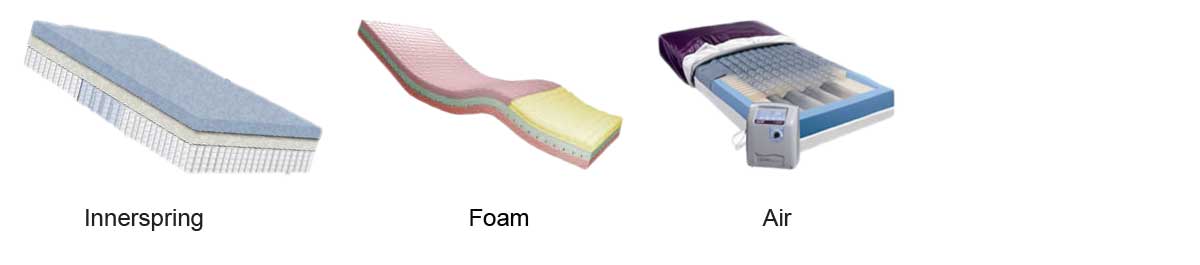
Modern medical bed mattresses are usually built around three main construction types. Each type uses different materials and has different cost and performance characteristics. The list below moves from lower average cost to higher average cost.
- Innerspring – employs steel coils.
- Foam – uses soft synthetic material.
- Air – functions with air cells or baffles.
Innerspring Mattresses
Innerspring mattresses use metal coils that may be interconnected or individually wrapped. The coil system provides rebound, support, and some pressure relief. Many manufacturers temper the coils with heat to improve strength and durability. Key selection points for innerspring sleep surfaces include coil type, coil gauge (thickness), total coil count, and the number of working turns in each coil.
Coil Configuration Types
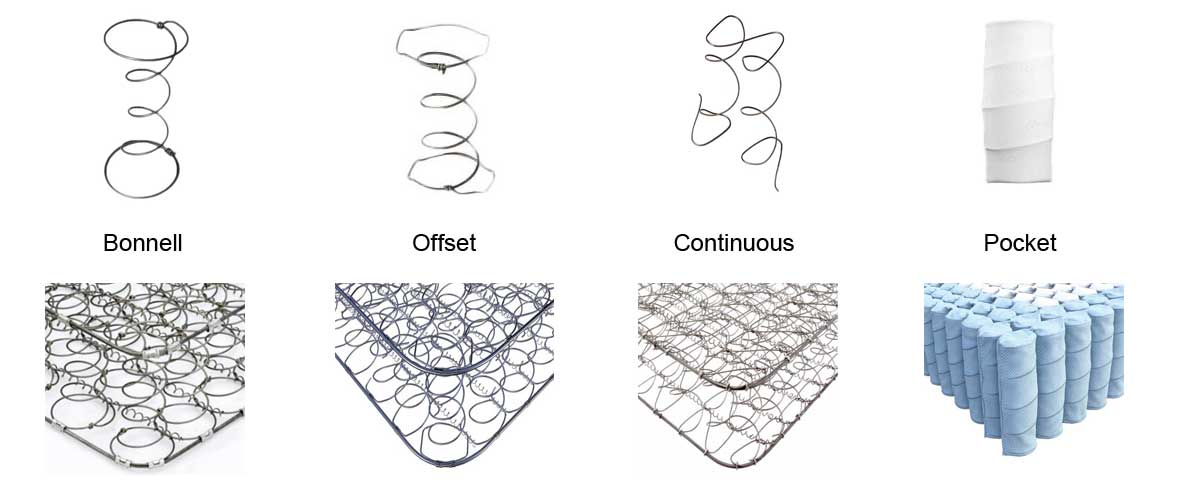
Common coil configurations include Bonnell, offset, continuous wire, and encased coils. Bonnell and offset coils provide traditional innerspring performance. Continuous coils tend to hold their shape longer than some classic designs. Encased coils offer more body-contouring support and can limit motion transfer between sides of the bed.
Bonnell coils are hourglass-shaped springs that are wider at the top and bottom and narrower in the middle. They are among the oldest and most commonly used coil designs. Bonnell systems are usually less expensive to manufacture and are often found in lower- to mid-priced mattresses.
Offset coils have flattened tops and bottoms that still form an hourglass profile. These flattened sections are joined with helical wires, creating a hinged effect that allows the surface to follow the body’s natural curves. Offset coils are typically found in higher-end innerspring mattresses and are known for stability.
Continuous coils are formed from a single steel wire shaped into rows of S- or loop-shaped springs that run from head to foot. The rows are linked together to create a consistent, stable support system across the mattress.
Pocket coils are barrel-shaped, thin-gauge coils that are each wrapped in a fabric pocket. This design supports the body more precisely and helps reduce motion transfer between sleepers. Because pocket coil systems are more complex to produce, they are usually used in higher-end sleep surfaces.
Coil Count
The number of springs in an innerspring mattress can vary widely. Many sleep surfaces contain between 250 and 1,000 coils, with larger sizes typically holding more coils. In general, higher coil counts support the body more evenly, assuming similar coil quality. Tempered steel coils usually offer the longest service life. Tempering is a reheating process that increases the strength of the steel.
The average coil count for hospital innerspring sleep surfaces is usually in these ranges:
- Standard size: 35- to 38-inch width – about 200 coils
- Extra-wide size: 42- to 54-inch width – about 300 coils
Coil Gauge
Coil gauge describes the thickness of the steel wire. A lower gauge number means a thicker coil. Lower gauge coils tend to feel firmer and often last longer. Higher gauge coils feel softer and more springy. Selecting the right gauge depends on the desired balance between firmness and cushioning.
Average Coil Gauge
12 to 15
Working Turns
Working turns refer to the number of 180-degree turns in each coil. This measure shows how tightly the spring is wound for Bonnell, offset, and pocket coils. A higher number of working turns can increase responsiveness, softness, and durability when combined with proper materials.
Tempering
Tempering is the process of repeatedly heating and cooling the coils to strengthen the steel and stabilize the coil shape. Tempered coils tend to be more durable and provide more consistent support over time than non-tempered coils.
Innerspring Advantages
- Provides supportive surface with some cooling airflow
- Offers stronger edge support than many foam designs
- Pocket coils increase product life and reduce motion transfer
- Often less expensive than comparable foam or air mattresses
Innerspring Disadvantages
- Low-quality innerspring mattresses with few coils, thin wire, or untempered springs may lack support and durability.
- Poorly built coils can shift or break through the surface over time.
Top Selling Innerspring Mattresses
A best-selling example of an innerspring hospital mattress is the Bonnell coil model from Invacare, the Invacare Deluxe Innerspring Hospital Bed Mattress. This mattress has a coil count of 312, a 13.75 coil gauge, and 3.5 working turns per spring. The coils are double-tempered for additional durability and strength.
Another frequently selected product is the Medline Innerspring Mattress. This mattress supports up to 250 pounds and includes a vinyl cover that is fluid-resistant and antimicrobial.
Foam Mattresses
Types of Foam
Foam mattresses use engineered foam layers to provide support and comfort. Five main foam types are commonly used in mattress construction.
Polyurethane foam is made from petrochemicals. It is generally the least expensive and lowest density option. This foam may off-gas and can develop body impressions over time. The typical life span is about 4 to 6 years, depending on usage and density.
Memory foam is made from petrochemicals with additional ingredients that increase density and softness. It offers contouring comfort and pressure relief by responding slowly to weight and heat. Memory foam can provide a deep “sink-in” feel and is often used as a comfort layer on top of a more supportive base. It tends to retain heat more than other foams. Many memory foam mattresses have an expected life span of about 10 years.
Gel memory foam is created by combining memory foam with gel beads or gel-infused materials. It provides density and contouring similar to memory foam but is designed to disperse heat more effectively. Typical life span is also around 10 years.
High-resilience (HR) foam is a type of polyurethane foam made from polyol and diisocyanate. It is often used under memory foam layers. HR foam has a more responsive bounce and less sink than traditional memory foam. Many HR foams also serve for 10 years or more when used properly in mattress cores.
Latex foam is made from natural or synthetic rubber. It provides elastic responsiveness, pressure relief, and cooler sleep compared to many memory foams. Latex is usually the most durable foam type, with some products lasting up to 12 years.
Foam Density
Foam density measures the weight of one cubic foot of foam and is usually expressed in pounds per cubic foot (PCF). Higher-density foams tend to last longer but may feel firmer and respond more slowly when compressed. Typical density ranges include:
Low density: 2 to 4 pounds
Medium density: 4.1 to 5.5 pounds
High density: above 5.5 pounds
Foam Layers
High-quality foam mattresses often use multiple layers to balance support and comfort. Support layers may use lower-density foam that provides a stable base, while upper comfort layers use higher-density foam that offers cushioning and pressure relief. Some manufacturers add gel components to surface layers to improve air circulation near the body.
Advantages of Foam Mattresses
- Distributes body weight more evenly across the surface
- Provides a consistent, cushioned sleeping surface
- Can offer moderate airflow depending on design
- Supports spinal alignment when properly constructed
- Reduces motion transfer between sleepers
- Operates quietly
Disadvantages of Foam Mattresses
- May not feel firm enough for individuals who prefer very rigid support
- High-density foams may retain more heat
- Some foams can off-gas from manufacturing chemicals
- Limited rebound compared to innerspring designs
- Often provides less edge support than coil-based mattresses
- High-density memory foam can resist movement and may feel restrictive for some users
Top Selling Foam Mattresses
The Medline High Performance Fiber Mattress is a lower-cost option. This mattress includes a waterproof vinyl cover that is antimicrobial and has inverted side seams. It supports up to 250 pounds and includes a 1-year warranty.
The Invacare Solace Prevention Mattress uses zoned, dual-layer high-density foam with softer sections at the head and foot. It is designed to provide pressure relief for patients at risk of pressure ulcers. The 70-denier nylon cover is fluid-resistant. The surface supports up to 300 pounds and includes a 5-year warranty.
Air Mattresses
Air mattresses for hospital beds use air cells to adjust support and relieve pressure. Three key features are common in these systems: alternating pressure, low air loss, and lateral rotation. Some models have only one of these features, while others combine all three.
Alternating Pressure
Alternating pressure mattresses inflate and deflate groups of air cells on a cycle. This shifting pattern changes pressure points against the body over time. Alternating pressure therapy helps stimulate circulation and can assist in the prevention and treatment of skin maceration and pressure ulcers. This option is especially important for patients who are unable to reposition independently and for those at higher risk for pressure injuries.
Low Air Loss
Low air loss mattresses circulate air through the mattress, often at a rate of about 100 liters per minute, to help relieve pressure, manage moisture, and maintain a more stable skin temperature. The surface fabric allows vapor to pass through so moisture can move away from the skin. These systems are often recommended for individuals at high risk for pressure ulcers and for those who tend to feel hot or sweaty during sleep.
Lateral Rotation
Lateral rotation mattresses combine pressure redistribution with gentle turning therapy. Rows of air cells inflate and deflate in sequence to rotate the patient along a head-to-foot axis. This movement changes the contact area between the body and the mattress over time and can be useful for patients at the highest risk for pressure wounds who cannot turn independently.
Alternating Pressure vs. Low Air Loss
Low air loss mattresses focus on airflow to help keep the skin dry and cooler while also providing pressure relief. Both moisture control and pressure management are important in the prevention and treatment of pressure ulcers. Alternating pressure mattresses use cycles of inflation and deflation to shift load from one body area to another. Some advanced systems combine low air loss with alternating pressure to provide a more comprehensive approach.
List of the Top Selling Hospital Air Bed Mattresses with links to detailed product information
Top Selling Low Air Loss Mattresses
Top Selling Alternating Pressure Mattresses
Top Combination Low Air Loss and Alternating Pressure Mattresses
Top Selling Lateral Rotation Mattresses
Air Mattress Advantages
- Adjustable support settings
- High comfort potential for many users
- Supports prevention and treatment of pressure ulcers
- Helps disperse and redistribute pressure points
- Alternates pressure points over time
- Helps limit moisture buildup on the skin
- Can reduce heat buildup around the body
Air Mattress Disadvantages
- May be more difficult to get on or off for some patients
- Dependent on a powered pump or control unit
- Requires a stable electrical source
- May produce noise from the motor during operation
- Usually requires some assembly and setup
- Generally higher purchase cost than basic foam or innerspring mattresses
An extensive list of hospital bed manufacturers and hospital bed options can be viewed at the following link: Hospital Bed Mattresses FOR SALE.
Guidelines for Selecting a Hospital Bed Mattress
- Firmness – Sleep surfaces range from soft to firm. Many clinicians and studies suggest that firmness plays a large role in support. A surface that is too firm can make it hard to fall asleep or remain asleep. A surface that is too soft, such as very thick memory foam, can make it harder to move or get out of bed. Many users find a medium-firm mattress provides a workable balance.
- Motion transfer – Movement by one person in the bed can transfer to another person. Mattresses designed to limit motion transfer help both sleepers stay asleep when one person changes position frequently.
- Breathability – Air-permeable mattresses allow heat and moisture to move away from the body, which can support comfort and skin health. Selecting a design and material set that promotes air circulation can be especially important for patients at risk of skin breakdown.
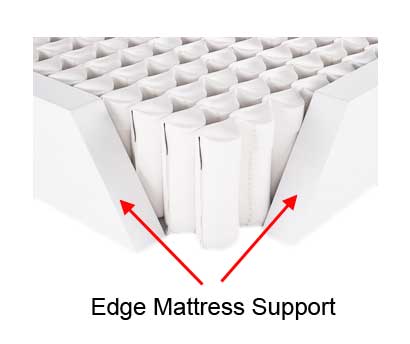
- Edge support – Weak edges can compress too much when a person sits or lies near the side of the bed. Many manufacturers add firmer foam or reinforced edges to keep the sides more stable and make transfers safer.
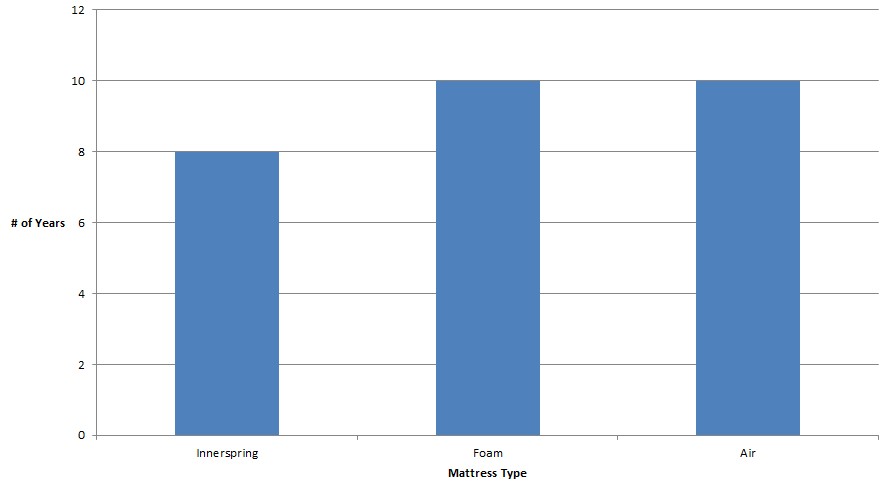
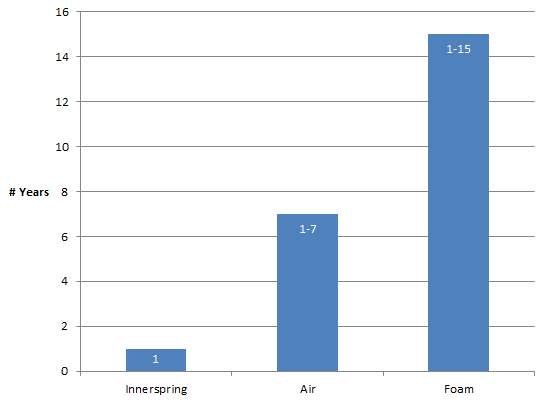
- Lifespan – Short-lived sleep surfaces may wear out quickly and become uncomfortable. Construction quality, materials, and design all influence lifespan. The chart below shows typical life spans for well-constructed hospital bed mattresses.
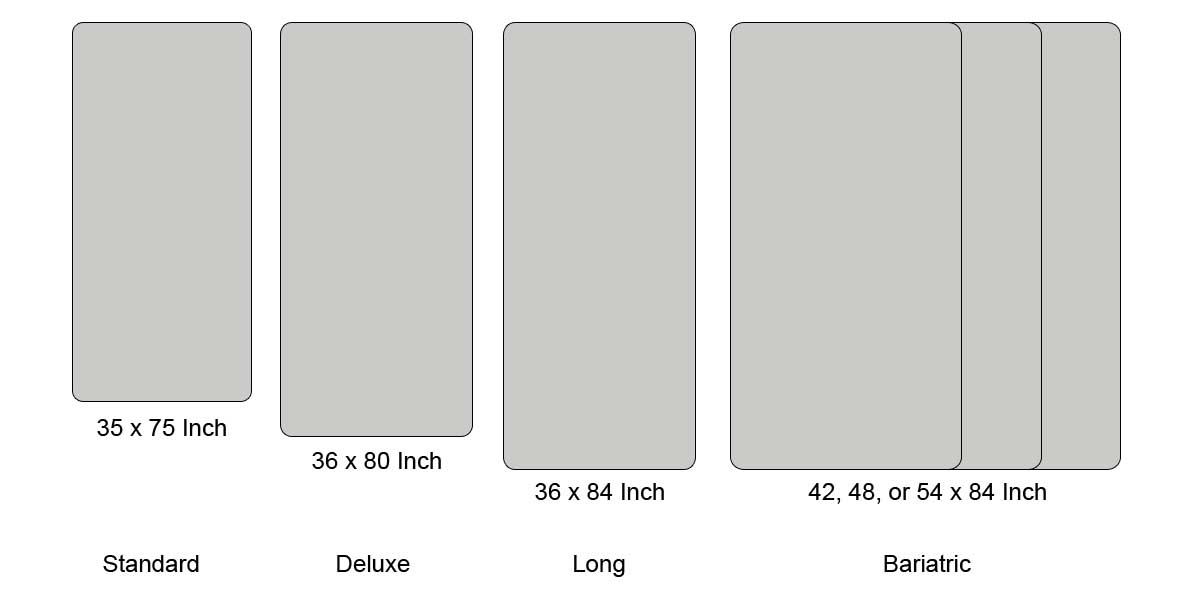
- Size – A mattress should be long and wide enough for the intended user. Bariatric patients often need extra-wide mattresses in the 42- to 54-inch range. Taller users may require 80- to 84-inch lengths to rest comfortably.
- Cost – Innerspring mattresses usually have the lowest initial cost, followed by foam. Air mattresses are generally the most expensive but offer more advanced pressure management options.
- Warranty – Warranty length offers a general guide to expected durability. Many foam hospital mattresses are designed for up to 10 years of use. Innerspring designs often have an expected lifespan of around 8 years. Air surfaces may last 8 to 10 years, depending on components and maintenance.
Frequently Asked Questions (FAQ's)
What is the best mattress for a hospital bed?
For intensive pressure management, many clinicians select an air mattress that offers both low air loss and alternating pressure. These systems provide adjustable support, moisture control, and pressure redistribution. They are also among the most expensive options and may require more frequent replacement. Some patients use an air mattress overlay placed on top of a foam or innerspring mattress to gain some of the same benefits. For patients at very high risk of pressure ulcers, a rotational air mattress may be considered.
Do hospital beds require a special mattress?
Yes. Hospital beds raise and lower at the head and foot. The mattress must flex with these movements without kinking or breaking down. Mattresses designed for standard flat beds may not bend safely on an adjustable hospital frame.
Does Medicare pay for hospital bed mattresses?
In certain situations, Medicare Part B may cover medically necessary durable medical equipment prescribed by a licensed physician, which can include a hospital bed and related support surface. Equipment must meet coverage rules and be supplied by an authorized provider. Coverage details and patient costs depend on the specific benefit and plan.
Does Medicare pay for air mattresses?
In qualifying situations, Medicare Part B “covers air-fluidized beds and other support surfaces as durable medical equipment that your doctor prescribes for use in your home” up to 20 percent of the approved amount, after the deductible.3 Coverage is subject to medical-necessity criteria and supplier participation.
What is a low air loss mattress?
A low air loss mattress circulates air through internal chambers to relieve pressure, help control moisture, and support more stable skin temperatures. Users often report sleeping cooler, drier, and more comfortably than on non-powered surfaces.
What is an alternating air pressure mattress?
An alternating air mattress inflates and deflates air cells in a sequence. This shifting pattern changes pressure points over time and can help reduce the risk of pressure ulcers by limiting constant load on the same area of skin.
Are firm mattresses better for the back?
Many people with back discomfort do well on a medium-firm mattress. A very firm surface can feel uncomfortable and may make it harder to fall asleep or stay asleep. A very soft surface might not provide enough support for the spine. The ideal firmness level varies by body size, sleep position, and clinical needs.
What firmness of mattress is often used for lower back pain?
WebMD cites a study of 300 people with low back pain over 90 days that found medium-firm mattresses to be the most comfortable in that group.4 Comfort and support needs still vary by individual, so input from a clinician can be helpful.
Which is better, foam or spring mattress?
Foam hospital bed mattresses often provide durable support with less motion transfer and a more uniform surface. Many are chosen for people with back pain or those who are sensitive to movement.
Innerspring hospital bed mattresses may provide more airflow through the core, which can support a cooler sleep environment. They often have more natural rebound and can be less expensive than some foam designs.
When both types are constructed with high-quality materials, overall support and comfort can be similar. One study comparing sleep on a high-quality innerspring mattress and a foam support surface reported the following:
The comparative effects of sleep patterns and rates of cyclic alternating patterns (CAP rate) in a high quality innerspring mattress were compared to those on a unique foam support mattress in 10 normal subjects. Results showed no differences in sleep stages, number of wakes, or total sleep time between the two conditions. CAP rates were significantly reduced on the foam surface.5
What are the parts of a mattress?
- Core – provides the main support base.
- Middle layers – add support and connect the firm core to the softer comfort layers.
- Comfort layers – provide cushioning and pressure relief near the body.
Do air mattresses help with bedsores?
Therapeutic air mattresses are designed to help prevent and manage pressure ulcers. Alternating pressure systems redistribute weight over time so that one area of the body is not exposed to constant pressure. Low air loss features help move heat and moisture away from the skin, which are important factors in pressure injury risk.
Are air mattresses more effective than foam mattresses in preventing and treating pressure ulcers?
A study published in JAMA reported that low air loss beds showed greater effectiveness than foam mattresses in healing certain pressure ulcers.
Results indicate more than a threefold improvement in median rate of healing for low-air-loss beds compared with foam mattresses … deep and superficial subgroups using low-air-loss beds remained 2.5 times more likely to heal in a given length of time compared with those using foam mattresses.6
10 Best Hospital Bed Mattresses Rankings
- Drive Medical 14027 Low Air Loss Mattress
- Invacare SPS1080 Solace Prevention Foam Mattress
- Drive Medical 15076 Quick n Easy Comfort Mattress
- Drive Medical 15019 Therapeutic 5 Zone Support Mattress
- Drive Medical 15770 Gravity 7 Mattress
- Invacare 5185 Innerspring Mattress
- Drive Medical Innerspring Mattress
- Drive Gel Overlay Mattress
- Proactive Protekt Aire 1500
- Invacare Barmatt39 Bariatric Mattress
The following link offers a summary of each of the Top Ten Hospital Bed Mattresses FOR SALE.
Footnotes
- 1 Zamosky, Lisa. How to Pick Your Perfect Mattress. WebMD. WebMD Feature. Reviewed by Louise Chang, MD on January 22, 2010 (last accessed November 22, 2019)
- 2 Kenney, S. Rithalia, L. "Hospital bed mattresses: an overview of technical aspects." Journal of medical engineering & technology 24.1 (2000): 32-39. (last accessed December 12, 2019)
- 3 Zamosky, Lisa. Air-fluidized beds." Medicare.gov. The Official U.S. Government Site for Medicare. A federal government website managed and paid for by the U.S. Centers for Medicare & Medicaid Services. (last accessed December 17, 2019)
- 4 Best Mattress for Lower Back Pain." WebMD. WebMD Medical Reference. Reviewed by Nayana Ambardekar, MD on February 06, 2019 (last accessed December 19, 2019)
- 5 Scharf, Martin B., et al. "Comparative effects of sleep on a standard mattress to an experimental foam surface on sleep architecture and CAP rates." Sleep 20.12 (1997): p. 1200. (last accessed December 12, 2019)
- 6 Ferrell, Bruce A., Dan Osterweil, and Peter Christenson. "A randomized trial of low-air-loss beds for treatment of pressure ulcers." JAMA 269.4 (1993): 494-497. (last accessed December 12, 2019)
Manuals and Documents
- Zamosky, Lisa. How to Pick Your Perfect Mattress. WebMD (last accessed November 22, 2019)
-
 Kenney, S. Rithalia, L. "Hospital bed mattresses: an overview of technical aspects." Journal of medical engineering & technology 24.1 (2000): 32-39. (last accessed December 3, 2019)
 - Kotowski, Susan E., et al. "Quantification of patient migration in bed: catalyst to improve hospital bed design to reduce shear and friction forces and nurses’ injuries." Human factors 55.1 (2013): 36-47. (last accessed December 3, 2019)
- Petzäll, Kerstin, B. Berglund, and C. Lundberg. "The staff’s satisfaction with the hospital bed." Journal of Nursing Management 9.1 (2001): 51-57. (last accessed December 3, 2019)
- Nishisaki, Akira, et al. "Backboards are important when chest compressions are provided on a soft mattress." Resuscitation 83.8 (2012): 1013-1020. (last accessed December 5, 2019)
- Schmidt, Richard S. "NASA pressure-relieving foam technology is keeping the leading innerspring mattress firms awake at night." Technovation 29.3 (2009): 181-191. (last accessed December 5, 2019)
- Scharf, Martin B., et al. "Comparative effects of sleep on a standard mattress to an experimental foam surface on sleep architecture and CAP rates." Sleep 20.12 (1997): 1197-1200. (last accessed December 5, 2019)
- Hawks, Leona K. "Selecting a Comfortable Mattress." (1987): 1. (last accessed December 5, 2019)
- Ferrell, Bruce A., Dan Osterweil, and Peter Christenson. "A randomized trial of low-air-loss beds for treatment of pressure ulcers." JAMA 269.4 (1993): 494-497. (last accessed December 9, 2019)

Burt Cancaster, Author
Vitality Medical
7910 South 3500 East, Suite C
Salt Lake City,
UT
84121
(801) 733-4449
burtcandoit@gmail.com
Vitality Medical
Login and Registration Form