TL;DR
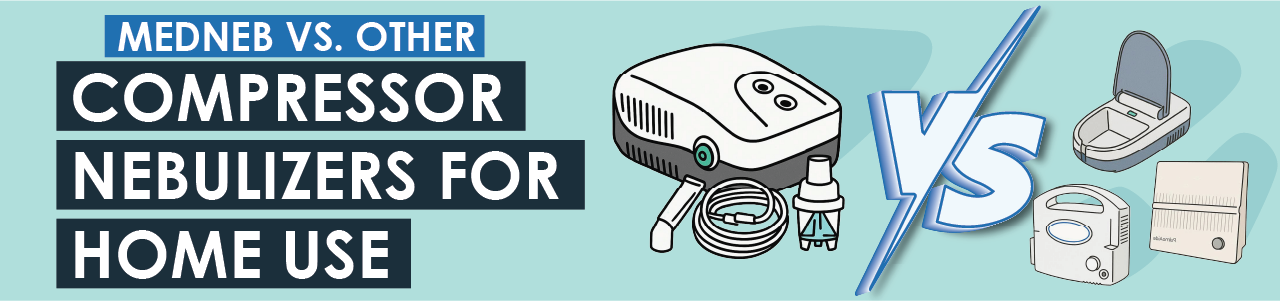
MedNeb is closest to compact home compressor nebulizers such as the Omron CompAIR NE-C801, while Drive Power Neb Ultra and DeVilbiss Pulmo-Aide Compact lean more toward larger tabletop home use. DeVilbiss Traveler stands apart because its battery-capable setup and transport support make it more travel-oriented than basic compact home compressors.
MedNeb is often compared with Omron CompAIR NE-C801, Drive Power Neb Ultra, DeVilbiss Pulmo-Aide Compact, and DeVilbiss Traveler because all of them sit in the compressor nebulizer category. They do not all represent the same kind of compressor setup. Some are smaller compact home units, some have a stronger tabletop presence, and some are built more clearly around portable use.
That difference matters because the comparison is not just about branding. It is also about how each unit handles common real-world issues such as storage space, portability claims, included accessories, setup style, and long-term home use. MedNeb’s product page emphasizes compact size, 7-foot kink-resistant tubing, six included filters, and a bag with select kits. Other recognized models differentiate more through smaller published dimensions, built-in holders, built-in storage, or battery-capable transport support.
Jump To
| Model | Compressor Category | Published Size And Weight | Included Or Notable Accessories | Comparison-Relevant Difference | Common Real-World Angle |
|---|---|---|---|---|---|
| MedNeb | Compact home compressor nebulizer | 6.7 in. x 5.4 in. x 3.5 in.; 2.6 lbs. | Standard nebulizer, 7-foot kink-resistant tubing, six air filters, bag with select kits | Longer tubing and extra filters are more noticeable than brand recognition alone | Often framed around value, compact use, and included kit details |
| CompAIR NE-C801 | Very compact home compressor nebulizer | 5 5/8 in. W x 2 7/8 in. H x 3 7/8 in. D; approx. 9.5 oz. | Nebulizer kit, 100 cm air tube, mouthpiece, five spare filters, AC adapter, storage bag | Smaller published dimensions and included storage bag make it a cleaner compact-model comparison | Often associated with compact size and recognized-brand familiarity |
| Drive Power Neb Ultra | Tabletop home compressor nebulizer | 6.3 in. W x 3.0 in. H x 5.3 in. D; 3.2 lbs. | Disposable kit standard, optional reusable kit or pediatric mask, built-in neb kit holder | Holder convenience and heavier tabletop feel separate it from smaller compact kits | Often associated with home tabletop convenience more than compact portability |
| Pulmo-Aide Compact | Durability-focused AC home compressor nebulizer | 7.5 in. W x 7.2 in. D x 4.0 in. H; 3.8 lbs. | Built-in storage, carrying handle, reusable nebulizer can be included depending on package | Built-in storage and sturdier mechanical positioning make it a different kind of home-use competitor | Often associated with durability, longer-term home setup, and a more fixed tabletop feel |
| DeVilbiss Traveler | Portable compressor nebulizer | 3.34 in. W x 2.2 in. H x 5.3 in. D; 1.5 lbs. | Masks, filters, carrying case, AC adapter, DC car adapter, battery-capable setup | Battery and car-adapter support place it in a more travel-oriented category than basic compact home compressors | Often associated with transport, portability claims, and away-from-home use |
The table is most useful when read as a comparison of compressor styles, not as a recommendation list. MedNeb and Omron sit closer together as compact home compressors. Power Neb Ultra and Pulmo-Aide Compact shift the comparison toward larger tabletop presence and a different home-use feel. Traveler changes the conversation because it introduces battery-capable portability rather than just smaller desktop size.
Technical Specifications
This table isolates the published technical specifications that are more useful for side-by-side reference. It avoids repeating the accessory and carry details already covered in the main comparison table.
| Model | Power | Operating Pressure / Airflow | Particle Size | Medication Capacity | Warranty | Technical Note |
|---|---|---|---|---|---|---|
| MedNeb | 120V AC, 60Hz | 35 to 55 psi | 0.5 to 5 microns | 10 mL max | 5 years | Piston-style compressor |
| Omron CompAIR NE-C801 | 100 to 240V AC, 50/60Hz | Approx. 0.3 mL/min nebulization rate | MMAD approx. 3 microns | 7 mL max; 2 mL min | 3 years | Very compact compressor with low listed sound level |
| Drive Power Neb Ultra | 120V AC, 60Hz | 8 lpm | 0.5 to 5 microns | 10 mL max | 5 years | Piston-style compressor |
| DeVilbiss Pulmo-Aide Compact | 120V AC, 60Hz | 30 psig max pressure; 12 lpm free air flow | 5 microns or less MMAD | 10 mL supplied nebulizer capacity | 5 years | TOBI-approved when used with PARI LC Plus |
| DeVilbiss Traveler | 100-240V AC, 50-60Hz; 12VDC, 1.5A; rechargeable battery | 30 psig max pressure or greater; 6 lpm free air flow or greater | 5 microns MMAD | 6 mL supplied nebulizer capacity | 3 years compressor; 1 year battery | Battery runtime approx. 45 minutes |
How These Competitors Differ In Real-World Use
One of the most common comparison issues is that all five models can be described as compressor nebulizers, but that label hides meaningful differences. Some comparisons are really about compact home handling, some are about a sturdier tabletop setup, and some are about portability that extends beyond room-to-room movement.
- MedNeb and Omron: The comparison usually centers on compact size, lighter handling, and basic home setup.
- Power Neb Ultra and Pulmo-Aide Compact: The comparison usually centers on a more established tabletop presence, built-in convenience features, or a sturdier long-term home-use feel.
- DeVilbiss Traveler: The comparison usually centers on transport support, battery use, and whether portability means more than a smaller footprint.
This matters because user positives and complaints often follow those category differences. Compact units are discussed more in terms of footprint, lighter handling, and included setup pieces. Tabletop units are discussed more in terms of built-in features, storage, or long-term home presence. Traveler-style models are discussed more in terms of transport support and portability expectations.
What The Accessory Differences Actually Change
Accessory differences are one of the more practical parts of this comparison. MedNeb’s 7-foot kink-resistant tubing and six included filters affect setup differently than Omron’s included storage bag, Power Neb Ultra’s built-in nebulizer holder, Pulmo-Aide Compact’s built-in storage compartment, or Traveler’s carrying case and transport-oriented power options. These details affect how the compressor is set up, stored, handled, and maintained over time.
That is also where positives and complaints tend to appear. A longer tube may be viewed as more flexible in home use. Extra filters may reduce the need for an immediate reorder. A built-in holder or built-in storage compartment may make a unit feel more organized during repeated use. A carrying case and added power options may make portability claims feel more credible in actual transport situations.
Why Portability Causes So Much Confusion
Portability is one of the most confusing comparison points because the term is used too broadly. In one sense, portability means a unit is smaller and lighter for easier handling around the home. In another sense, portability means the device is supported by features such as battery use or car-adapter use. Those are different product angles, and the comparison tables separate them.
That distinction is important because it explains why MedNeb and Traveler should not be treated as interchangeable portable devices. One represents compact home portability. The other represents a more travel-oriented design with transport support built into the product setup. That is a product-category difference, not just a difference in wording.
Summary
This comparison shows which models stay closest to the compact home-compressor category, which shift toward a sturdier tabletop home-use profile, and which portability claims are tied to actual transport support rather than lighter size alone.
It also shows how MedNeb competitors separate into different compressor types and home-use patterns, and why those differences appear in handling, setup, storage, portability claims, and long-term use.

Login and Registration Form