Click a link to jump to the section.
- Understanding Male and Female Catheter Lengths
- Catheter Length vs. French Size
- Intermittent and Foley Catheters
- Straight, Coude, and Hydrophilic Options
- Compact Female and Standard-Length Catheters
- Catheter Materials and Other Product Differences
- Male External Catheters vs. Urethral Catheters
- Choosing the Correct Catheter
- Frequently Asked Questions
Introduction
Urinary catheters are designed to drain urine from the bladder or collect urine as it exits the body, depending on their configuration. Whether it be from incontinence, neurological disorders, urinary retention, or post-surgery recovery, catheters can help people retain a sense of normalcy and handle their urinary issues. However, catheters are not universal. Male and female catheters are designed with their respective anatomies in mind.
Understanding Male and Female Catheter Lengths
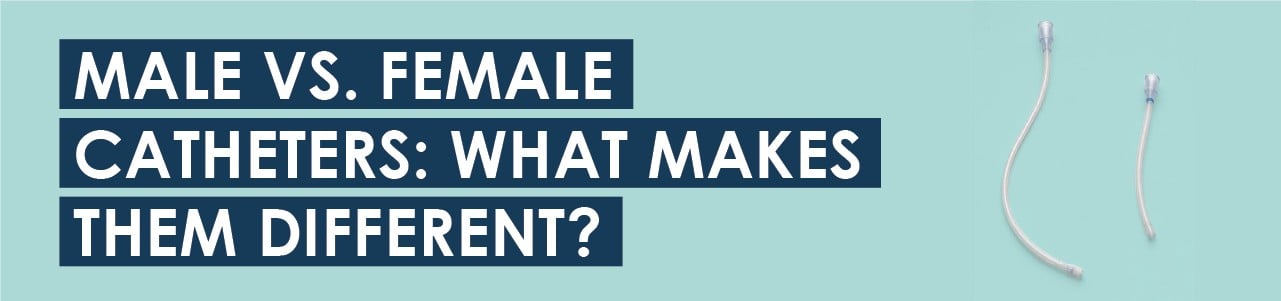
One of the major differences between male and female catheters is their lengths. The female urethra is only around 1.5 inches long, while the male urethra is around 7 to 8 inches. Because of this, female catheters are typically shorter than their male counterparts.1
It is important to note that sizes vary between manufacturers, as well as the ranges available for the male and female catheters.2
Catheter Length vs. French Size
The two main measurements used to describe catheters are the length and French size. The length is self-explanatory and described above. The French, or Fr, describes the diameter of the catheter. One French is equivalent to 0.013 inches, or 0.33 millimeters, and catheters can range from 6 Fr to 26 Fr.
Typical French sizing is as follows:
- 6 Fr - 10 Fr are usually pediatric sizes
- 10 Fr - 12 Fr are the average sizes for adult women
- 14 Fr - 16 Fr are the average sizes for adult men
Other applications to consider regarding adult French sizing:
- 12 Fr - 14 Fr may be recommended for the drainage of clear urine
- 14 Fr - 16 Fr may be recommended for urine with debris or particles
- 18 Fr and above may be recommended for urine with blood clots
Keep in mind that the French size a healthcare professional prescribes will be based on the patient’s anatomy and their urinary issues. Similar to lengths, the French sizes provided by different manufacturers may vary. Checking both specifications when purchasing a catheter is important, as an improperly sized catheter can cause irritation or trauma to the bladder.3
Intermittent and Foley Catheters
An intermittent catheter is a temporary, single-use device for draining urine from the bladder. The catheter may be inserted by a healthcare provider and removed after drainage, though self-catheterization can be taught by a professional. The frequency of catheterization depends on the individual's prescribed bladder management routine.
Foley catheters are a type of indwelling catheter that uses a balloon to hold the catheter in place. These catheters are intended to be kept inserted for longer periods of time, which is up to a medical professional’s discretion. Foley catheters have two channels: one for draining urine and the other, which is accessed by healthcare providers to inflate the balloon with sterile water. The balloon rests inside the bladder and holds the catheter in place long-term. There are also three-way Foley catheters, in which the third channel is used to irrigate the bladder.4
There is no major difference across catheter types for males and females other than the previously stated length and French sizes.
Straight, Coude, and Hydrophilic Options
Straight-Tipped Catheters
Straight catheters have a simple construction and are used for uncomplicated urinary drainage. Two straight tipped catheters are Coloplast’s Self-Cath for Men and Coloplast’s Self-Cath for Women. As shown in the specifications and descriptions, the male catheters are longer and occupy a slightly wider range of French sizes.
Coude-Tipped Catheters
Coude tips are curved upwards and used to navigate blockages in the urethra, such as those caused by an enlarged prostate. Other Coude configurations exist, such as the Tiemann-Coude tips, which are narrower and more tapered to help navigate through urethral strictures.
Hydrophilic Catheters
Hydrophilic catheters have a water-activated lubricant that helps reduce irritation and discomfort during insertion.
Compact Female and Standard-Length Catheters
Compact catheters for women are designed around discretion and portability. The packaging is usually around 2-3 inches in length - about the size of a lipstick tube - and can fit easily inside purses or pockets. The products themselves can vary in length. Compact catheters can only come as intermittent catheters, since they are meant to be portable and disposable.5
Some women may still need to use standard-length catheters, such as those who require indwelling catheters.
Male External Catheters vs. Urethral Catheters
Male external catheters provide an option for urine drainage and collection that avoids insertion. They adhere to the tip of the penis and allow urine to drain into a collection bag. They may also fit over the penis as a condom-style catheter. These are noninvasive options as opposed to urethral catheters. However, some people may require an internal catheter.
Sizing for external catheters is different from their internal counterparts and is typically based on external anatomy. Sizing guides provided by manufacturers should be referenced when selecting an external catheter.
Catheter Materials and Other Product Differences
Materials don’t differ between male and female catheters, just between manufacturer and catheter type. Some common catheter materials include the following:
- Silicone
- Polyvinyl Chloride (PVC)
- Latex
- Plastic
- Rubber
It is important for buyers to note what materials a catheter is made of to avoid materials one is sensitive to or that may cause irritation.
Frequently Asked Questions
What is the main difference between male and female catheters?
Male and female intermittent and Foley catheters are very similar, but typically have different measurements to better fit their respective anatomies.
Are male catheters wider than female catheters?
Male and female catheters have similar French sizes, and they can even use the same French sizing; however, some male catheters do have wider options. The diameter of the catheter can also correspond to whether the user needs to drain more than just urine.
Can male-length catheters be used by women?
Women can use standard male-length catheters when recommended by a healthcare professional. Shorter female-specific catheters may be more convenient for some individuals. Follow your clinician's recommended length rather than relying on simple “male” or “female” labels.
Can female-length catheters be substituted for male urethral catheterization?
Female catheters are usually much shorter than male catheters and will not be able to reach the bladder when inserted. If the retention balloon of a Foley catheter is inflated inside the urethra, it can cause severe trauma. Follow your clinician’s recommended length rather than relying on simple “male” or “female” labels.
Footnotes
- 1 "A Guide to Female Catheters: Types and Tips for Proper Care." Coloplast. Accessed 20 November 2026.
- 2 "Male Catheters: Types, Uses, and Frequently Asked Questions." Coloplast. Accessed 20 November 2026.
- 3 "Intermittent and Foley Catheter Size Guide." Liberator Medical Supply. Accessed 23 November 2026.
- 4 "Urinary Catheter." Cleveland Clinic. Accessed 23 November 2026.
- 5 "Female Catheters: The Complete Guide." Express Medical Supply. Accessed 24 November 2026.

Login and Registration Form