
TL;DR: Redness, itching, bumps, drainage, warmth, or pain can have several possible causes during tattoo healing. Location, timing, pattern, and progression provide useful context, but they cannot confirm whether the problem is irritation, excess moisture, an adhesive or ink reaction, or infection. Worsening pain, spreading redness, increasing warmth or swelling, concerning drainage, fever, chills, or a tattoo that is not healing should be evaluated by a healthcare professional.
Unexpected changes in a healing tattoo can be difficult to interpret because normal inflammation, friction, trapped moisture, product reactions, and infection may initially look similar. The goal is not to diagnose the skin from a description or photograph, but to organize the available clues and determine the appropriate next step.
Look Beyond Appearance: Do not ask only, “What does it look like?” Also ask where the change appears, when it began, what products touched the skin, and whether it is improving or worsening.
Jump to a Section
- Start With Three Context Clues
- Expected Healing or an Unexpected Change?
- Patterns That May Provide Context
- When Infection Is a Possibility
- Choosing the Appropriate Next Step
- When Product Changes May Be Relevant
- Bottom Line
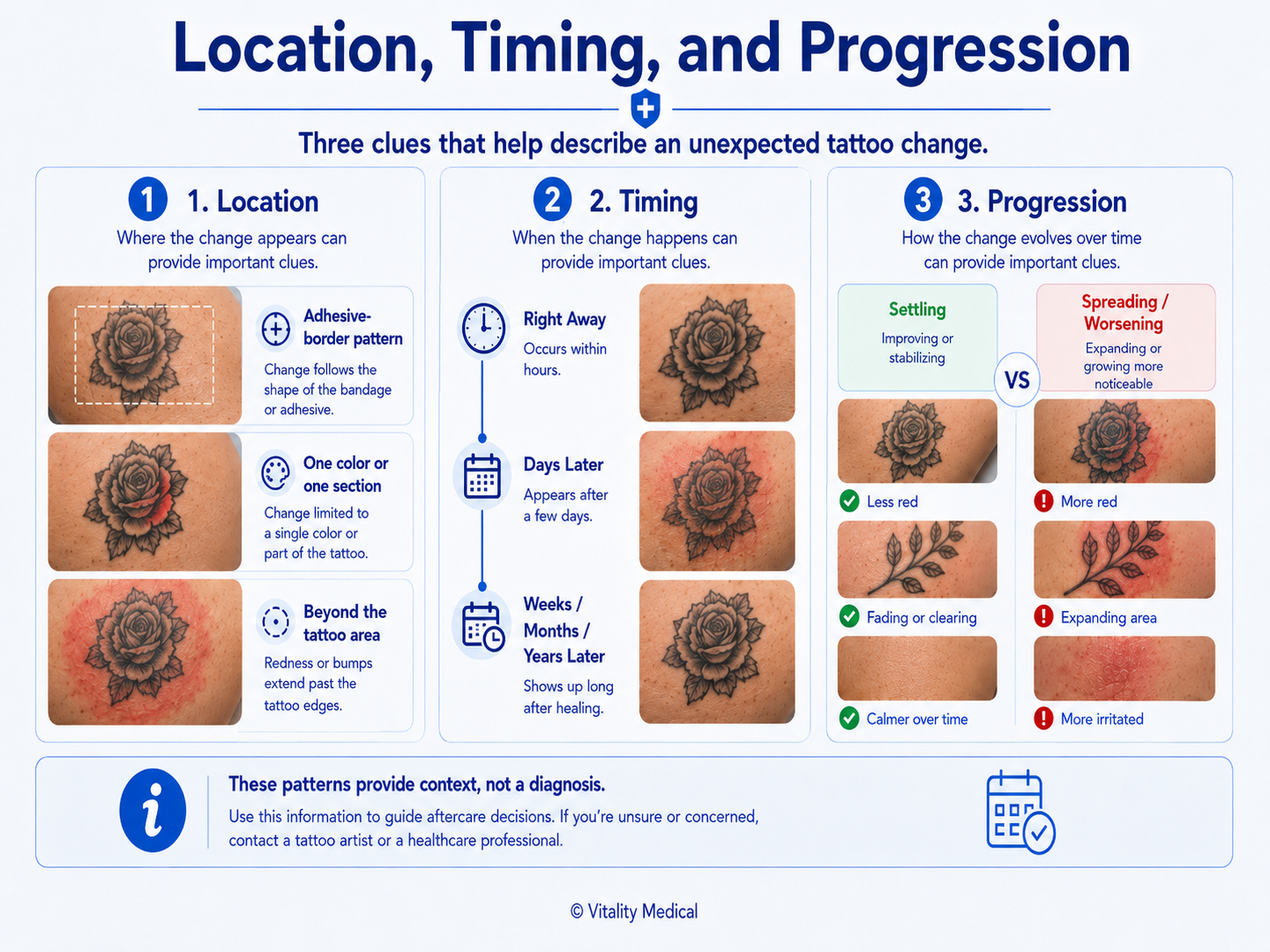
Start With Three Context Clues
A single symptom rarely identifies the cause. Redness, itching, tenderness, and bumps become more meaningful when considered with location, timing, and progression.
1. Location
Is the change limited to one ink color or spread across the entire tattoo?
Does it follow the border or rectangular outline of film or tape?
Is it concentrated where clothing, shaving, or movement repeatedly contacts the skin?
2. Timing
Did it begin immediately after tattooing or several days later?
Did it appear after using a new film, tape, cleanser, lotion, or ointment?
Is this a new change in a tattoo that is months or years old?
3. Progression
Is the area gradually settling or remaining unchanged?
Is redness spreading or becoming darker?
Are pain, warmth, swelling, drainage, or general illness increasing?
The American Academy of Dermatology notes that tattoo reactions can appear immediately or develop weeks, months, or years later.2 Timing may narrow the possibilities, but it does not establish a diagnosis.
Expected Healing or an Unexpected Change?
Early redness, mild swelling, soreness, itching, and some clear surface fluid can occur with a new tattoo. These changes should generally begin settling rather than becoming increasingly hot, swollen, painful, widespread, or persistent.
Need the Normal-Healing Baseline? Review What Does Normal Tattoo Healing Look Like? for the expected surface-healing stages without repeating the full timeline here.
Patterns That May Provide Context
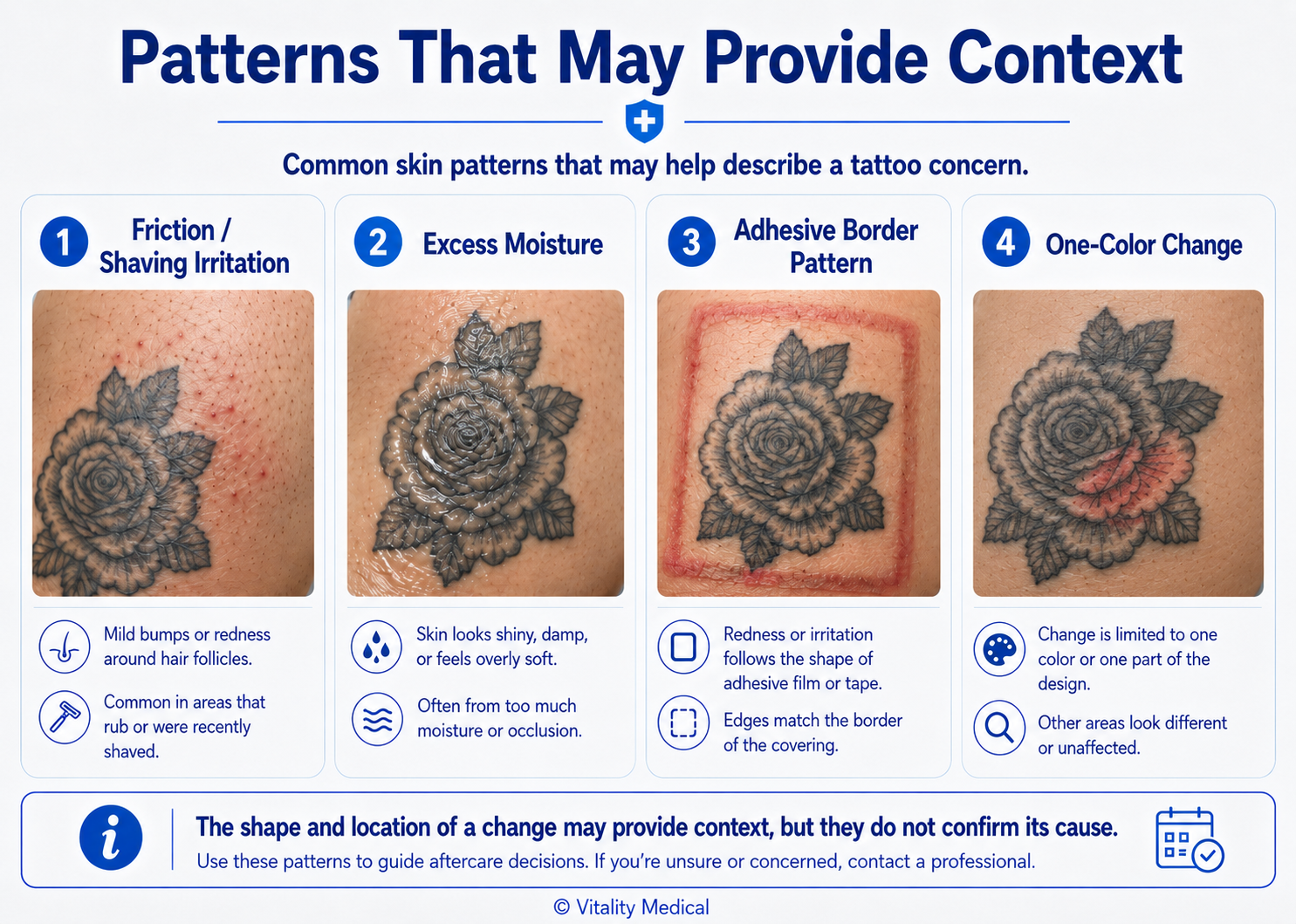
The patterns below can help organize what is happening, but none should be used as a diagnostic test.
| Pattern | Useful Context | What Not To Assume |
|---|---|---|
| Friction, Shaving, or Follicle-Centered Bumps | Clothing, bedding, repeated movement, shaving, or heavy products may irritate the surface or contribute to small bumps. | Do not label the bumps as acne, folliculitis, allergy, or infection from appearance alone. |
| Persistently Wet, Sticky, or Heavily Coated Surface | Heavy lotion or trapped moisture may leave the skin greasy, softened, or congested. | Excess moisture does not rule out another problem, and simply drying the tattoo may not resolve every change. |
| Border- or Rectangle-Shaped Change | A pattern matching the shape of film or tape makes adhesive or contact irritation worth considering. | The shape is useful context, not proof of an adhesive allergy. |
| Changes Limited to One Ink Color | Persistent itching, bumps, swelling, or firmness limited to part of the design may suggest that the ink placement or color is relevant. | Do not assign a specific ink allergy or inflammatory condition without medical evaluation. |
| New Changes in an Older Tattoo | New bumps, itching, swelling, firmness, or color-specific changes are not part of routine fresh-tattoo healing. | Do not assume every delayed change is an ink allergy. Persistent changes should be evaluated. |
Friction, Moisture, and Recently Introduced Products
When a change is mild and not worsening, review what has recently contacted the tattoo. Reduce unnecessary rubbing and follow the artist’s directions for gentle cleansing and light moisturizing. A thick coating should not be used to keep the tattoo continuously wet.
Adhesive-Shaped Irritation
Removing film or tape will end additional adhesive contact, but it does not guarantee that redness, itching, bumps, or discomfort will resolve immediately. Do not automatically place replacement film over an actively concerning area. Discuss an alternative covering with the tattoo artist only when ordinary irritation is suspected, and medical evaluation is not otherwise indicated.
Ink Reactions and Older Tattoos
Changes may remain limited to one ink color or appear long after the tattoo was completed. Persistent itching, bumps, firmness, swelling, or other unexplained changes in an older tattoo warrant professional evaluation rather than fresh-tattoo aftercare advice.2
When Infection Is a Possibility
The FDA warns that tattoo infections can initially resemble allergic reactions or other inflammation, potentially leading to misdiagnosis and ineffective treatment.1 An online photograph or checklist cannot reliably confirm or rule out infection.
Seek Healthcare Guidance for Concerning Progression Such As:
- Pain, warmth, redness, or swelling that continues to increase
- Redness or other changes spreading beyond the original area
- Pus-like or otherwise concerning drainage
- Fever, chills, sweating, or feeling generally unwell
- Open sores or a tattoo that is not healing
- Any change that causes significant concern or uncertainty
The AAD recommends medical evaluation when tattoo redness darkens or spreads, pain worsens, pus or open sores develop, or fever and chills occur.2 Do not delay care while experimenting with new products or coverings.
Choosing the Appropriate Next Step
The tattoo artist can identify products and explain the intended aftercare plan. A healthcare professional evaluates the skin and determines whether treatment is necessary.
Contact the Tattoo Artist About
The ink brand, colors, and available batch or lot information
The wrap, film, tape, cleanser, ointment, or lotion used
The intended covering removal or replacement schedule
Whether fit, friction, movement, or routine product use may be affecting the tattoo
Contact a Healthcare Professional About
Worsening pain, heat, swelling, redness, or drainage
Changes spreading beyond the tattoo or adhesive area
Fever, chills, sweating, or feeling unwell
A tattoo that is not healing
Persistent reactions, older-tattoo changes, or any situation that causes concern
The FDA recommends informing the tattoo artist when a reaction or infection is suspected so the ink and other product information can be identified.3 That information may assist a healthcare professional but does not replace medical evaluation.
When Product Changes May Be Relevant
Product changes may reduce unnecessary variables when ordinary irritation, friction, or excess moisture is suspected. They should not delay evaluation of a possible infection or another worsening reaction.
- Fragrance-Free Products: A simple fragrance-free cleanser or moisturizer may reduce exposure to added fragrance or unnecessary ingredients.
- Non-Adhesive Coverage: A non-adhesive option may be discussed when adhesive irritation is suspected.
- Non-Adherent Pads: Sterile non-adherent pads serve a different purpose from transparent adhesive film and may require separate securement.
- Adhesive Removers: These may assist with film removal or residue but do not treat a rash or reaction.
Tattoo Aftercare Supplies: View appropriate cleansers, moisturizers, transparent dressings, non-adherent options, and removal supplies on the tattoo aftercare supplies page. Do not place a new occlusive covering over a potentially infected or actively concerning area without professional guidance.
Do not self-treat a suspected complication with topical antibiotics, steroids, antiseptics, or specialty wound dressings unless directed by a qualified healthcare professional.
Bottom Line
Tattoo irritation, adhesive reactions, excessive moisture, ink reactions, follicle-centered bumps, and infection can overlap in appearance. Location, timing, pattern, and progression provide context but not a diagnosis.
The tattoo artist can identify the inks, covering, and products used. A healthcare professional should evaluate worsening or systemic symptoms, a tattoo that is not healing, or a persistent or unexplained reaction.
Related Guides in This Series
- What Does Normal Tattoo Healing Look Like?
- Second Skin vs Traditional Tattoo Aftercare
- Is a Healing Tattoo Infected, Irritated, Over-Moisturized, or Reacting to Adhesive?
- Life After a New Tattoo: Showering, Sleeping, Exercise, Swimming, Work, and Sun

Login and Registration Form