
Quick Summary:
This blog is a guide to bathroom safety products and organization methods to help keep the bathroom safer to use for you or your loved one, preventing falls and other common injuries.
Click a link to jump to a section.
Introduction
Bathrooms are among the most essential yet also the most dangerous rooms in the house. Wet surfaces, slippery floors, poor lighting, and sharp corners make the bathroom a hazardous place for older adults.
Falls are the leading cause of injury for adults over 651, and the bathroom is the most likely place for them to happen. Falls don't have to be inevitable, however; they can be completely preventable with the use of safety aids and simple bathroom adjustments.
Why You Should Take Potential Falls Seriously
Many adults experience mobility and balance problems as they age, and more than 80% of bathroom injuries2 are caused by slipping and falling.
Falls can cause serious injuries and can hurt your quality of life. Each year, about 1 in 4 older adults report a fall, and 1 in 10 experience a fall-related injury3. Falls are known as one of the leading causes of traumatic brain injury hospitalizations4, and falls are the cause of approximately 83% of hip-fracture-related deaths5.
Even seemingly minor injuries, such as broken bones, can pose challenges for older adults because healing capacity declines with age. It is difficult to recover from a hip fracture, and many older adults are not able to live independently after experiencing a hip injury.
1. Identifying Common Bathroom Hazards
Common bathroom hazards include, but are not limited to:
- Low Lighting:
Bathrooms are often the dimmest rooms in the house, which can make navigation difficult, especially for those with poor vision. - Using Unreliable Support:
Older adults may rely on faucets, shower doors, soap dishes, and other fixtures for support when navigating the bathroom. This is dangerous because these items are not designed to support body weight and may break, potentially causing falls. - Using the Faucet:
Arthritis, reduced grip, and chronic pain can make it difficult or painful for older adults to use faucets, especially knob faucets that twist. - Getting in and out of the Bathtub:
High bathtub walls and slippery bathtub floors can cause older adults to trip, slip, and fall. - Bending, Reaching, or Straining:
Out-of-reach or high-up items can be hazardous for older adults, especially those with balance issues. Having to reach or strain to reach items can cause further strain and worsen existing aches and pains. - High Water Temperature:
Water that is too hot can easily burn sensitive skin. - Throw and Bath Rugs:
Traditional bath rugs and mats are slippery, creating a tripping hazard. - Hard, Slippery Surfaces and Sharp Corners:
Bathrooms are filled with hard surfaces - tile, porcelain, marble, and more that get wet and slick, making it easy to slip and fall. These hard surfaces also have sharp corners that can cause additional injury in a fall.
2. Fall Prevention and Stability Aids
Preventing falls is simple with the right products. Here is a breakdown of the bathroom safety products available and why they're essential for preventing falls.
Grab Bars and Handrails
Bathroom grab bars are designed to support an adult's body weight and are bolted securely into the wall for stability. They can be installed at the exact height and placement most suited to the user, providing support while bathing, showering, or using the toilet.
Non-Slip Bath Mats and Strips
Non-slip products, such as mats and strips, significantly improve stability because, as their name suggests, they grip the floor securely and won't slide or move. Non-slip strips are installed on the bathtub or shower floor to provide traction on an otherwise slippery surface. Non-slip bath mats do the same, but they cover a larger surface area and won't slide under your feet or shift like traditional bath mats.
Shower Chairs and Transfer Benches
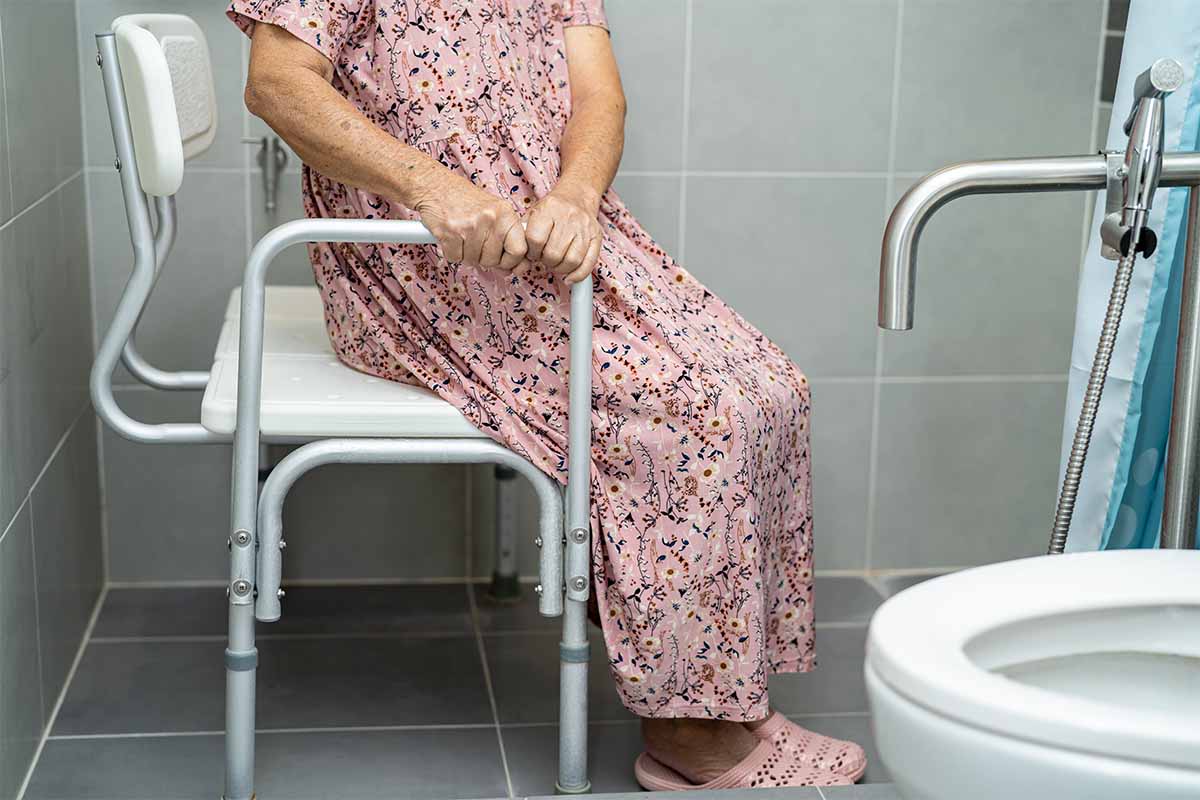
Shower chairs ease strain and transfer benches improve safety when entering and exiting the tub or shower. Shower chairs provide a stable seat while showering, reducing strain and preventing balance issues from standing for extended periods. Transfer benches also do this, while providing a safe route for entering and exiting the shower or tub.
3. Toilet and Sink Accessibility
Getting up and sitting down can be strenuous for older adults with mobility issues or chronic pain. A raised toilet seat can reduce the effort required to get on and off the toilet, providing greater independence and reducing the risk of falls. Toilet safety frames offer extra stability, giving users a secure grip to prevent falls.
Even simple things like sinks can be difficult for older adults to use. Arthritis, joint pain, muscle reduction, and more can make it painful to grip and use bathroom fixtures. Hand-free, motion-activated faucets may be a helpful upgrade to reduce pain and discomfort from using the sink. If that's not possible, lever-style faucets, rather than knob faucets, can significantly reduce pain by eliminating the need to grip and twist.
4. Bathing and Shower Safety Equipment
There are additional ways to upgrade a bathroom to make it safer to use for older adults, including:
- Handheld Showerhead:
A handheld showerhead is especially helpful for people who shower with a shower chair. A handheld showerhead brings the shower to the user, allowing them to stand and thoroughly clean hard-to-reach areas. - Roll-In Showers:
Showers with a flat, edgeless surface make it easier for older adults using wheelchairs to roll in and out. - Tub Cutout Doors:
Tubs with a cutout door allow users to step into and out of the tub, reducing the risk of falls by eliminating the need to step over a high tub wall.
5. Lighting and Visibility Improvements
Studies show that inadequate lighting affects balance, especially for older adults at risk of falls. Nighttime visits with low lighting can be especially dangerous, as you're usually less alert. Motion-activated nightlights can help prevent falls when navigating the bathroom at night. Even during the day, the bathroom should be well-lit to help older adults with low vision.
Even high-contrast color changes on fixtures and walls can help older adults use the bathroom more easily. High-contrast color schemes6 can make it easier for people with low vision to focus on what they need.
6. Organizing the Bathroom for Safety
A simple reorganization can make the bathroom safer to use for older adults.
- Declutter and Ensure Floors Are Clear:
Go through all bathroom products and discard any that are no longer used or have expired. Make sure the floors are free of cords and tripping hazards. - Keep Essentials Nearby and Organized:
Keep the most-used products within easy reach for everyday use. - Organize Drawers with Storage Bins:
Organize cluttered drawers with clear storage bins. Sort products by category, and keep the most-used items in the top drawer for easy access.
Conclusion
With the proper modifications and bathroom safety equipment, you can make the bathroom a much safer place for you or a loved one. Taking precautions and planning the bathroom layout around your needs can help prevent slips and falls. Vitality Medical offers a wide variety of bathroom safety products from trusted brands and manufacturers. Shop our catalog to set your bathroom up for success today.
Footnotes
- 1 "Centers for Disease Control and Prevention. (2024, October 28)." Older adult falls data.
- 2 "Centers for Disease Control and Prevention. (2011, June 10)." Nonfatal bathroom injuries among persons aged ≥15 years --- United States, 2008.
- 3 "Bergen, G., Stevens, M. R., Kakara, R., & Burns, E. R. (2019, October 21)." Understanding modifiable and unmodifiable older adult fall risk factors to create effective prevention strategies. American Journal of Lifestyle Medicine, 15(6), 580–589.
- 4 "Peterson, A. B., Zhou, H., & Thomas, K. E. (2021)." Traumatic brain injury-related hospitalizations and deaths by age group, sex, and mechanism of injury: United States 2016/2017. Centers for Disease Control and Prevention.
- 5 "Moreland, B. L., Legha, J. K., Thomas, K. E., & Burns, E. R. (2022)." Hip fracture-related emergency department visits, hospitalizations and deaths by mechanism of injury among adults aged 65 and older, United States 2019. Journal of Aging and Health, 35(5–6), 345–355.
- 6 "Perkins School for the Blind." High contrast and low vision.

Login and Registration Form