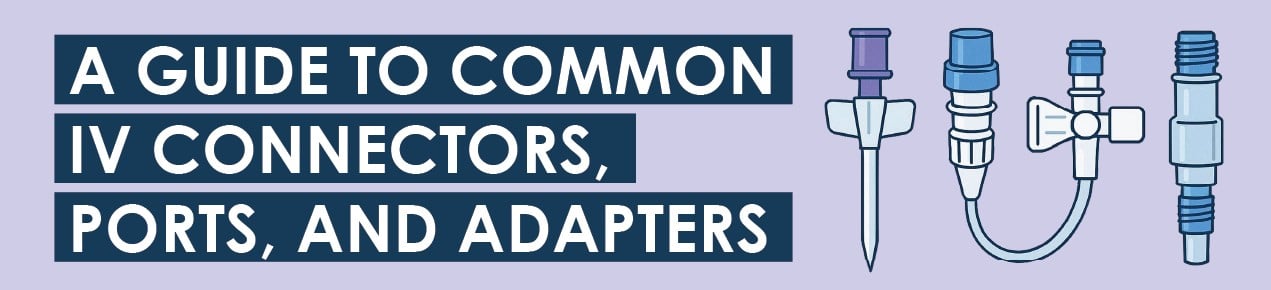
Quick Summary:
Intravenous therapy systems feature several elements that, when understood and used correctly, deliver medications and fluids to patients. There are several types of IV ports, connectors, and adapters available for various purposes. These components help protect both patients and caregivers by reducing the risk of contamination, accidental dislodgement, needlestick injuries, or leaks.
Common types of IV connectors include:
- Luer Lock
- Needleless
- Microclave
Common types of IV ports/vascular access devices include:
- Implanted IV ports
- Peripherally Inserted Central Catheters (PICC)
- Tunneled Central Venous Catheters (CVC)
Common types of adapters include:
- Spike
- Vial
- Luer Lock
Stay organized and always follow your doctor’s instructions for handling, storing, and using equipment safely.
This blog is intended for educational purposes only and should not be taken as medical advice.
Click a link to jump to the section.
Introduction
Each component of an infusion system setup serves a unique purpose in IV treatment.
IV ports and other vascular access devices are the intravenous therapy components that connect directly to the patient’s veins.
IV connectors secure the pathway for medications and other fluids to flow through IV tubing, catheter hubs, and infusion devices.
IV adapters are IV connectors with specialized purposes.
Understanding each of these parts helps caregivers and facilities manage IV supplies, streamlines equipment setup, and helps protect healthcare workers from exposure to hazardous chemicals when administering medication. This equipment helps reduce the risk of infection and helps protect patients from accidental IV dislodgement.
Overview of IV Connection Systems
IV systems are assembled from multiple components.
- Ports come into direct contact with the patient’s veins
- Connectors attach IV ports to catheter hubs
- Adapters connect to IV tubing to various types of medication containers
Primary IV devices, or ports, are vascular access devices that come into direct contact with the patient’s vein.
Connection accessories attach to the IV port and connect it to tubing and any other components of the infusion therapy system. 1
Common Types of IV Connectors
IV play a critical role in drug administration. They link tubing, catheters, and devices while reducing the risk of needlestick injuries or leaks.
Common IV tubing connector styles include:
Luer Lock Connectors
- Attach needles and catheters to the tubing
- Twist-lock technology helps reduce the risk of leaks
Needle-Free Connectors
- Help reduce the risk of needlestick injuries
Microclave connectors
- Are compatible with peripheral, arterial, and central venous catheters
- For delivering IV fluids, administering medication, and aspirating blood2
Common Types of Vascular Access Devices
IV ports and other vascular access devices attach directly to one of the patient’s veins. They allow medication delivery, flushing, and vein access.
Common vascular access devices include:
Implanted IV Ports
- Synonyms include: Mediport and port-a-cath
- Surgically inserted under the skin and attached to veins in the chest, arm, groin, or abdomen
- Available in single or double ports, depending on the patient’s infusion needs
- Surgically removed when the patient no longer needs them
Peripherally Inserted Central Catheters (PICC)
- Inserted into a vein in the patient’s arm
- No surgery necessary
- Covered by a transparent IV
- Must stay dry
- Available in up to three lines for multiple infusions
Tunneled Central Venous Catheters (CVC)
- Also known as Hickman, Groshong, or Broviac catheters
- Inserted through an incision in the patient’s skin on their neck or chest
- One end exits the patient's body through a different incision
- Secured with stitches
- Covered by an IV dressing
- Helps reduce the risk of accidental dislodgement
- Must stay dry
- Features up to three infusion lines3
Common Types of IV Adapters
IV adapters are IV connectors designed for specific infusion needs. They protect healthcare workers and patients by reducing the risk of tubing leaks during medication administration.
Common IV adapters include:
Spike Adapters
- Connect non-vented IV spikes to irrigation containers
- Puncture IV bags to access medication
Vial Adapters
- Help protect healthcare workers from exposure to hazardous drugs
- Provide a closed pathway for medication during administration
Luer Lock Adapters
- Connect to Luer Lock fittings
- Reduce the risk of blood reflux during infusions
- Help prevent catheter occlusions
- Help protect against needlestick injuries
Supply Replacement Considerations
Due to the nature of intravenous therapy, many IV connectors and adapters are single-use. Regularly replacing disposable IV components helps reduce the risk of infection or contamination.
Managing a consistent replacement supply rotation schedule necessitates an ample stock of bulk IV supplies. Doing so will also help ensure supply availability for patients needing ongoing infusion therapy, even during supply chain disruptions.
Vitality Medical offers autoship programs for connectors, ports, adapters, and other IV supplies. Ordering in bulk and scheduling regular deliveries often saves money and provides peace of mind. For assistance ordering or questions, contact our helpful customer service team at (800) 397-5899.
Handling, Storage, and General Safety Considerations
As with all other medical equipment, following the manufacturer’s guidelines is critical in maintaining the integrity and effectiveness of IV supplies. Proper IV handling is key to infusion safety.
Organized storage helps caregivers quickly locate supplies and encourages safe and efficient IV setup.
Conclusion
IV systems include three important elements: ports, connectors, and adapters. They play an important role in protecting patients by reducing the risk of dislodgement, infections, and occlusions. They help protect medical professionals by reducing exposure to hazardous chemicals and minimizing the risk of needlestick injuries.
IV ports and other vascular access devices connect to the patient’s veins. Depending on the type, they can attach to veins on the patient’s arm, groin, abdomen, chest, or neck.
Connectors link IV ports to tubing.
Adapters give IV systems access to various specialized medication containers.
Keep a well-stocked supply of reliable, compatible, up-to-date infusion supplies. Always follow professional medical advice when storing, using, and disposing of IV equipment.
Footnotes
- 1(N.d.). Basic Equipment and Supplies for Intravenous Therapy. Retrieved May 21, 2026, from https://musculoskeletalkey.com/basic-equipment-and-supplies-for-intravenous-therapy/.
- 2 Types of IV connectors: Clinical uses and selection guide. Mediplus Innovative Medical Devices. (2026, February 23). https://mediplusuk.com/knowledge-hub-article/what-are-the-different-types-of-iv-connectors/
- 2 American Cancer Society. (n.d.). Intravenous (IV) lines and ports used in cancer treatment. cancer.org. https://www.cancer.org/cancer/supportive-care/iv-lines-ports.html

Login and Registration Form