
Quick Summary:
IV tubing and IV administrations sets are often referred to interchangeably. This blog is a quick guide on IV set configurations and the purpose of different IV sets.
Click a link to jump to the section.
- Understanding IV Administration Sets and Tubing
- Primary and Secondary IV Tubing
- Gravity Administration Sets
- Pump-Compatible Administration Sets
- IV Extension Tubing and Sets
- Filtered IV Administration Sets
- Vented and Non-Vented Administration Sets
- Blood Administration Sets
- Volume-Control and Burette Sets
Introduction
Intravenous therapy, or IV therapy, is the process of administering liquids directly to the bloodstream through a vein. "IV tubing" may be used as a general term to mean IV sets, but it is only one component of a complete IV administration set.
Different IV administration sets may be used for different delivery methods and infusion therapy needs. This blog is a guide on general IV terminology and common IV sets.
Understanding IV Administration Sets and Tubing
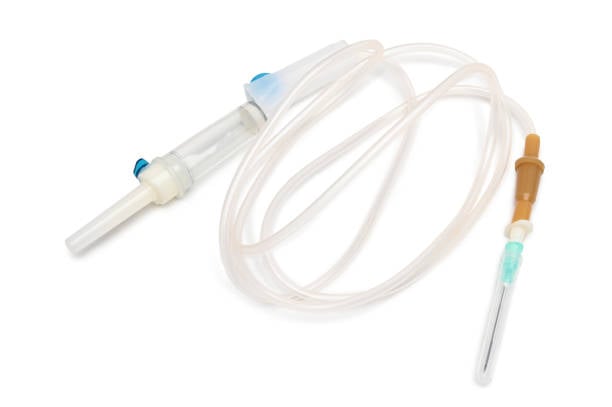
If you are new to IV therapy, you may hear people refer to IV sets and IV tubing interchangeably. Simply, an IV administration set is the system that connects the container to the patient's IV access site; IV tubing is a length of flexible tubing that makes up part of the IV administration set, allowing the fluid to travel to the access site.
IV components and administration sets include, but are not limited to:
- IV container: A flexible bag, bottle, or other container that holds fluids or medication.
- Spike: A sharp tip that pierces the IV container or IV bag, allowing fluid to pass from the container to the set.
- Air vent: Enables air to enter, helping maintain pressure balance for smooth liquid flow.
- Drip chamber: A transparent chamber that holds IV fluid and allows drops to form.
- Filter: Filters out outside particulates.
- IV tubing: Carries the IV fluid from the IV container to the patient.
- Roller clamp: Adjusts the flow rate, either increasing or decreasing the flow.
- Slide clamp: Quickly stops or starts the flow.
- Injection port: Allows for medication to be injected into the IV line without disconnection.
- Y-site connector: Two-pronged connector that allows for more than one medication to be injected into the IV line.
- Luer lock connector: Securely connects IV administration set to cannula or catheter.
- Back-check valve: One-way valve that prevents backflow from entering the IV container.
Not every set has the same components. IV administration sets can come in multiple configurations.
Primary and Secondary IV Tubing
Primary: The main line that runs directly from the IV container to the patient's vascular access device.
Secondary: Also known as "piggyback tubing", secondary tubing is connected to another bag or container. Secondary tubing contains fluid or medication to be infused over time at prescribed intervals without disconnecting the primary infusion therapy.
Gravity Administration Sets
Gravity administration sets are IV sets that use gravity to move fluid from the container to the patient without an infusion pump. The IV container is usually positioned above the patient, and the roller clamp or flow regulator manually controls the flow. It usually includes a drip chamber for observing the flow.
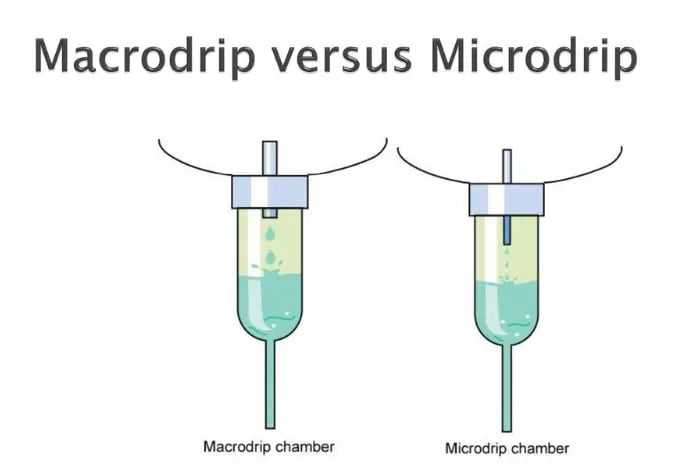
Gravity sets may use macrodrip or microdrip tubing, which are distinguished by drip factor:
- Macrodrip: Larger but less frequent drops. May be 10, 15, or 20 drops per milliliter.
- Microdrip: Smaller drops. Usually 60 drops per milliliter.
Pump-Compatible Administration Sets
Pump-compatible administration sets are intended to work with infusion pumps. Unlike gravity sets, pump-compatible administration sets are made to fit specific infusion pumps, and the pump controls fluid delivery. Not every administration set fits with every infusion pump.
IV Extension Tubing and Sets
IV extension tubing is an additional length of tubing that extends the line of the primary IV administration set. An IV extension set is a tubing-and-connector assembly that extends the tubing of an IV administration set.
An extension set may include:
- Clamps
- Additional luer connections
- Needle-free connectors
- Access ports
Filtered IV Administration Sets
Filtered administration sets use an inline filter that fluid passes through before reaching the patient. Filters are available in different pore sizes, and the most commonly used sizes are 0.2- and 1.2-micron.
Vented and Non-Vented Administration Sets
Vented IV administration sets include an air vent in the spike that lets air enter the IV container as fluid flows out. Clinicians often use vented sets with rigid or semi-rigid IV containers that do not collapse as fluid drains.
Non-vented sets are the opposite; they lack tubing vents. Non-vented IV sets are often used with flexible, collapsible IV containers like IV bags.
Blood Administration Sets
Blood administration sets are specifically designed for delivering blood. This type of set includes a blood filter, which is different than the filter found in a standard IV administration set. Blood administration sets may be used as a gravity or pump-infusion set.
Volume-Control and Burette Sets
Volume-control sets (also known as burette sets) have a graduated chamber (burette) that holds a limited amount of fluid, providing control over the amount administered.
Conclusion
IV administration sets help deliver IV fluids to the patient. They come in different configurations to serve a particular role in a patient's IV therapy. Vitality Medical has IV supplies from trusted manufacturers in stock now. Shop today!

Footnotes
- 1 Mintel Report - Incontinence - US - February 2021
- 2 Wing, Rena R et al. “Improving urinary incontinence in overweight and obese women through modest weight loss.” Obstetrics and gynecology vol. 116,2 Pt 1 (2010): 284-292. doi:10.1097/AOG.0b013e3181e8fb60

Login and Registration Form