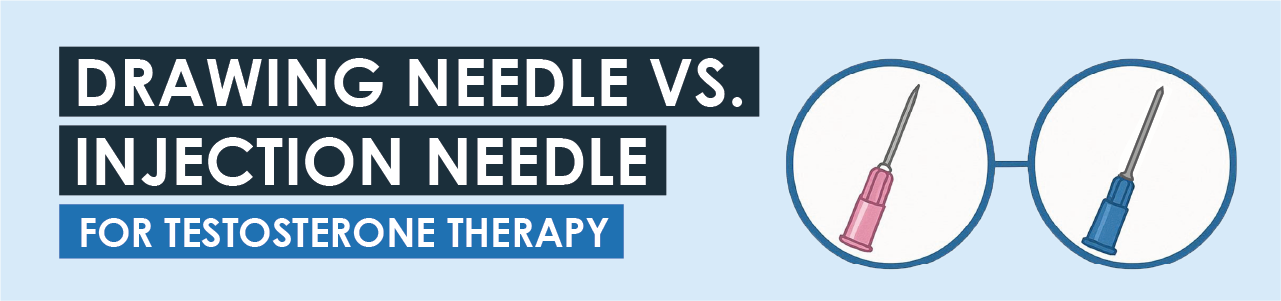
TLDR: Testosterone needle setups can be confusing because the drawing needle, injection needle, syringe, and connection type all need to work together. A drawing needle is used to draw medication from the vial, while an injection needle is used after the medication is in the syringe; therefore, a two-needle setup is part of the prescribed routine.
Understanding Testosterone Needle Setups
Drawing needle vs injection needle for testosterone is not just a definition question. The real issue is understanding how the syringe, draw needle, injection needle, and connection type work together when administering testosterone.
Due to testosterone's viscosity, it is recommended to use one needle to draw medication from the vial and another needle for the injection. This setup can affect the type of syringe used because a fixed-needle syringe cannot be changed, whereas a detachable-needle syringe allows separate draw and injection needles.
Needle gauge, needle length, syringe size, and injection method should follow the prescribing clinician’s instructions. This guide explains the needle and syringe relationship for drawing testosterone. This information is not intended to provide dosing, reconstitution, or injection instructions.
Jump to a Section
- Why Testosterone May Use Two Needles
- Drawing Needle Vs Injection Needle
- What Is A Drawing Needle?
- What Is An Injection Needle?
- Why Testosterone Can Be Slow To Draw
- Luer Lock Vs Luer Slip Syringes For Testosterone
- Fixed Needle Syringes Vs Detachable Needle Syringes
- Common Draw Needle And Injection Needle Mismatches
- Frequently Asked Questions
Why Testosterone May Use Two Needles
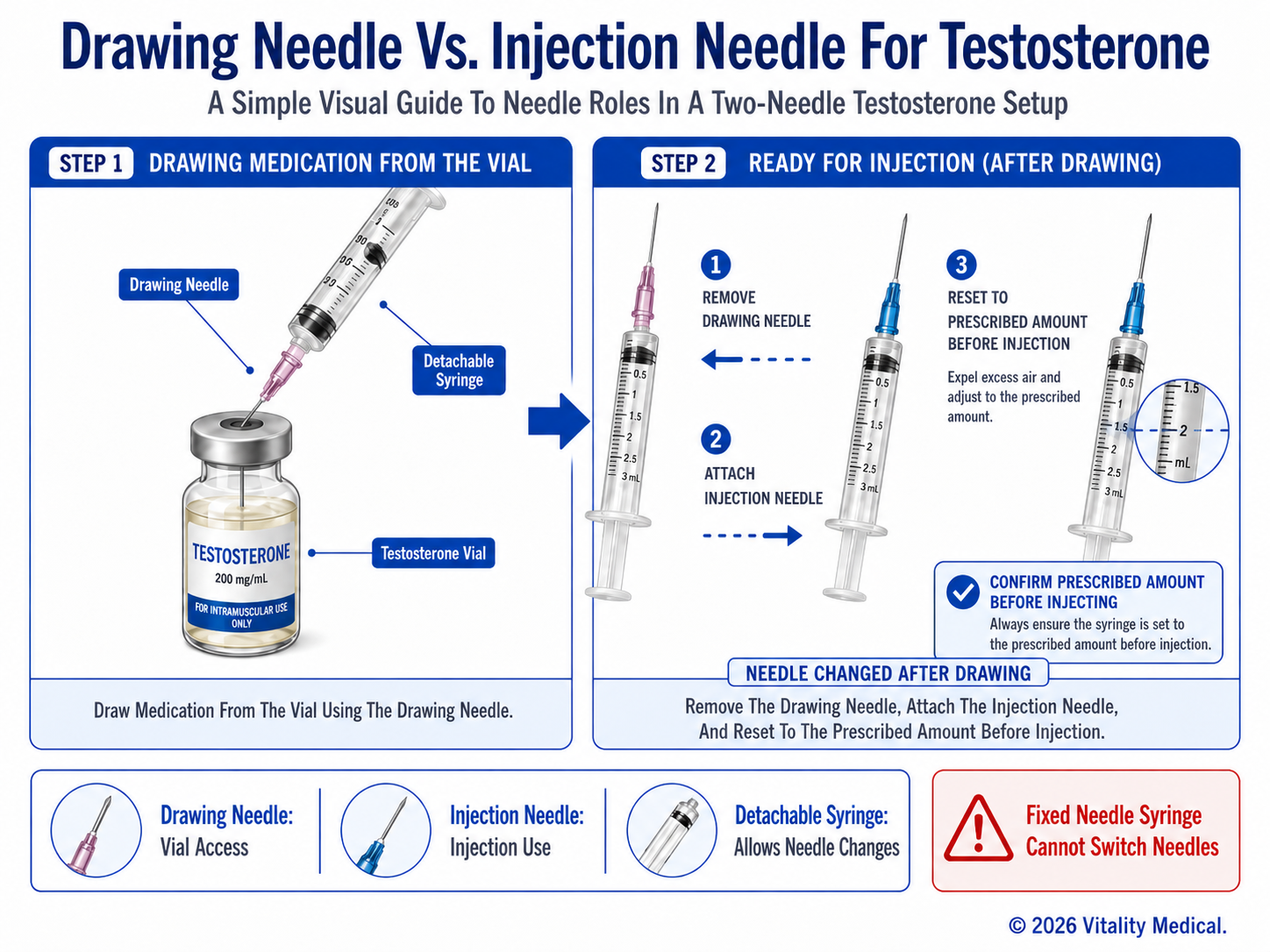
Testosterone supplies may include two needles because each needle can have a different role. The drawing needle is used with the testosterone vial. The injection needle is used after the medication is in the syringe when a separate injection needle is part of the prescribed routine.
This difference matters because the syringe must support the setup. A detachable needle syringe can allow the drawing needle to be removed and replaced with an injection needle. A fixed-needle syringe does not allow that change.
The main decision point is compatibility. The syringe connection, needle attachment style, draw needle gauge, injection needle gauge, and needle length all need to match the prescribed instructions.
| Part | Role In The Setup | Why It Matters |
|---|---|---|
| Drawing Needle | Draws testosterone from the vial into the syringe. | It may be different from the injection needle. |
| Injection Needle | Used after drawing when a separate injection needle is part of the routine. | Gauge and length should match the clinician's instructions. |
| Syringe | Holds the medication and connects to the needle. | The connection style determines whether separate needles can be used. |
Drawing Needle vs Injection Needle
A drawing needle and an injection needle are not always interchangeable in a testosterone needle and syringe setup. The drawing needle is used first with the vial. The injection needle is used after the medication is drawn when a two-needle setup is prescribed.
The comparison is not only about which needle comes first. It also affects syringe style, connection type, gauge, length, and whether the needle can be changed after drawing.
| Needle Type | Main Use | Connection Detail |
|---|---|---|
| Drawing Needle | Used to draw testosterone into the syringe. | Usually requires a compatible detachable syringe when a separate injection needle is used. |
| Injection Needle | Used for injection after drawing. | Must match the syringe connection and prescribed gauge and length. |
What Is a Drawing Needle?
A testosterone drawing needle is the needle used to draw medication from the vial into the syringe. In product listings, it is usually a detachable needle that connects to a compatible syringe.
Drawing needles are often discussed with testosterone because oil-based medication may move slowly through smaller needles. A product list may show a larger gauge option for drawing, but the correct gauge should come from the prescription, product instructions, or clinician guidance.
A drawing needle is not automatically the same as the injection needle. When a two-needle setup is used, both needles must fit the syringe connection.
- Used for vial access.
- Often paired with detachable syringes.
- Must match the syringe connection.
- May be sold separately from injection needles.
- Should follow the clinician's instructions.
What Is an Injection Needle?
A testosterone injection needle is the needle used after the medication has been drawn into the syringe. It may have a different gauge or length than the drawing needle, depending on the prescribed injection method and clinician instructions.
Product listings may include IM or subQ wording, needle gauge, needle length, sterile packaging, and connection type. These details help buyers understand which needle is meant for drawing and which is meant for injection.
If the injection needle is detachable, it must fit the syringe connection. If the syringe has a fixed needle, the needle cannot be changed after drawing.
Why Testosterone Can Be Slow To Draw
Testosterone can be hard to draw into a syringe because many testosterone medications, including testosterone cypionate and testosterone enanthate, are oil-based. Thicker liquid can move more slowly through a smaller needle.
This is why people may search for terms such as testosterone hard to draw, testosterone is hard to draw into a syringe, or why use a drawing needle for testosterone. The issue is often tied to needle role and syringe compatibility.
This does not mean a buyer should choose a larger needle without instructions. Needle gauge and length should match the prescription or clinician guidance. The purpose of this section is to explain why drawing needles appear in testosterone syringe and needle setup lists.
Luer Lock vs Luer Slip Syringes for Testosterone
Luer lock and Luer slip describe syringe connection styles for detachable needles. This matters when testosterone supplies include a drawing needle and an injection needle because both needles need to fit the syringe.
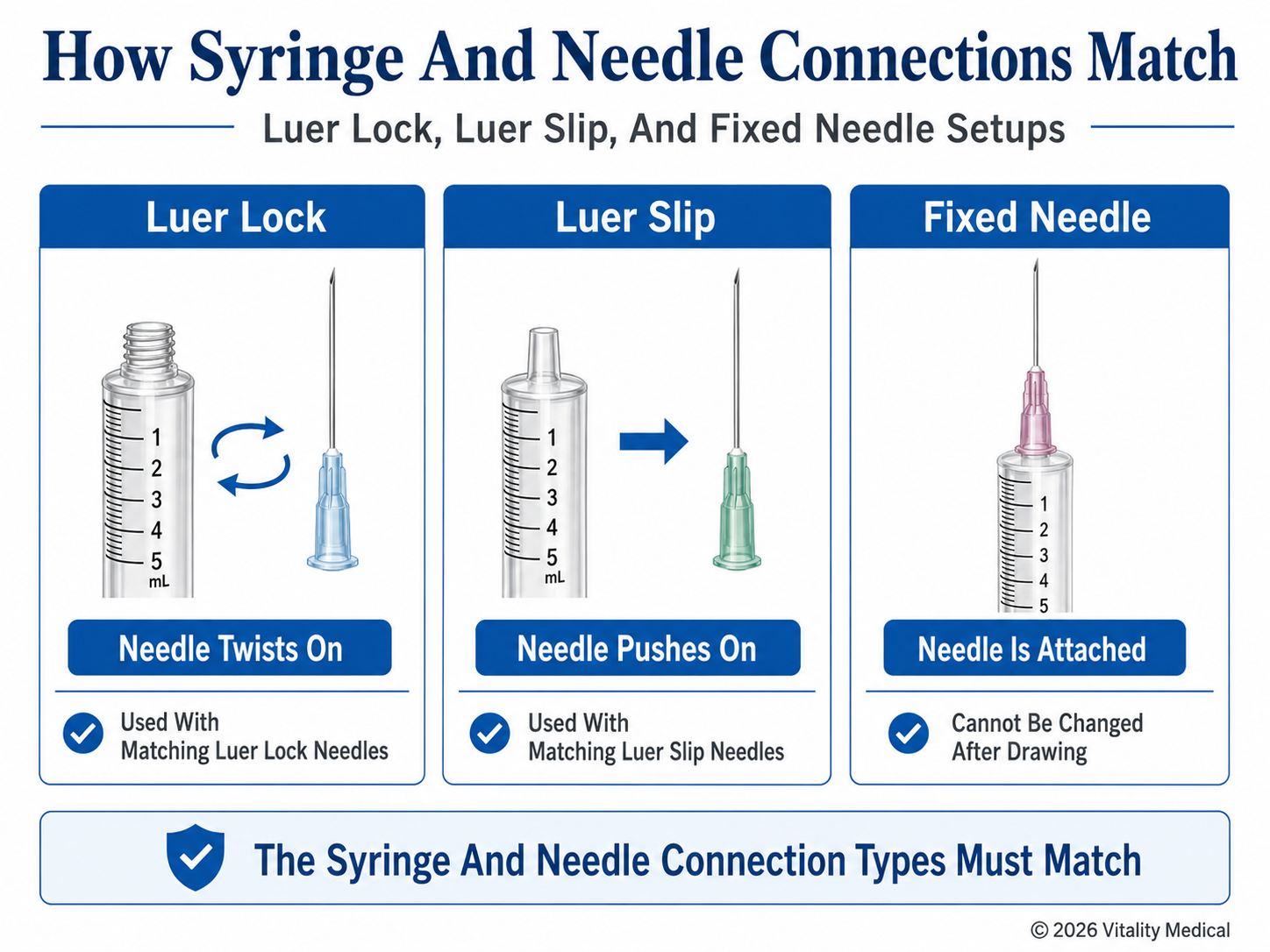
A Luer lock syringe uses a twisting connection that helps secure the needle to the syringe. A Luer slip syringe uses a push-on connection. Product listings should identify which connection type is used so buyers can match syringes and needles correctly.
Luer lock syringe for testosterone and Luer slip syringe for testosterone are common search phrases because buyers may see both options when comparing testosterone syringe supplies. The correct choice should match the ordered needles and the instructions provided by the prescriber or product listing.
| Connection Type | How It Connects | Why It Matters |
|---|---|---|
| Luer Lock | Needle twists onto the syringe connection. | Both drawing and injection needles need to match the Luer lock syringe. |
| Luer Slip | The needle pushes onto the syringe connection. | The needle connection must match the Luer slip syringe listing. |
| Fixed Needle | The needle is already attached to the syringe. | The needle cannot be changed after drawing. |
Fixed Needle Syringes vs Detachable Needle Syringes
A fixed needle syringe has the needle attached to the syringe. This can work for some single-needle supply setups, but it does not support a two-needle routine because the needle cannot be removed and replaced.
A detachable needle syringe allows compatible needles to be attached and removed. This is the type of setup buyers often compare when a testosterone prescription or supply list includes both a drawing needle and an injection needle.
Before ordering testosterone needles and syringes, check the product name and specifications for phrases such as fixed needle, detachable needle, Luer lock, or Luer slip. These details explain whether the syringe supports needle changes.
Common Draw Needle and Injection Needle Mismatches
Most problems with drawing needles and injection needles come from parts that do not match the intended setup. The syringe may not accept detachable needles, the connection type may not match, or the buyer may confuse the drawing needle with the injection needle.
| Mismatch | Why It Happens | How To Read The Listing |
|---|---|---|
| Fixed-Needle Syringe Used For A Two-Needle Setup | The needle is already attached and cannot be changed. | Look for a fixed needle, an attached needle, or a detachable needle. |
| Luer Lock Needle Paired With The Wrong Syringe | The syringe connection and needle connection do not match. | Compare the syringe connection type with the needle hub type. |
| Drawing Needle Confused With Injection Needle | Both products may be listed as sterile needles, but they have different roles. | Check gauge, length, role, and clinician instructions before selecting. |
| Needle Length Overlooked | Buyers may focus on the gauge and miss the length in the product title. | Read both gauge and length before comparing options. |
Frequently Asked Questions
What Is The Difference Between A Drawing Needle And Injection Needle For Testosterone?
A drawing needle is used to draw testosterone from the vial into the syringe. An injection needle is used after the medication is drawn when a separate injection needle is part of the prescribed routine.
Why Do People Use A Different Needle To Draw Testosterone?
Some testosterone routines use a separate drawing needle because testosterone is commonly oil-based and can draw slowly through smaller needles. The exact needle gauge and length should follow the clinician's instructions.
Can The Same Needle Be Used To Draw And Inject Testosterone?
Some routines may use one needle, while others may use a separate drawing needle and injection needle. Buyers should follow the instructions from the prescribing clinician and confirm whether the syringe setup supports needle changes.
Why Is Testosterone Hard To Draw Into A Syringe?
Testosterone can be slow to draw because many testosterone medications are oil-based. Thicker liquid can move more slowly through smaller needles, which is why drawing needle size is often discussed in testosterone supply lists.
What Is A Testosterone Drawing Needle Used For?
A testosterone drawing needle is used to draw medication from the vial into the syringe. It is usually part of a detachable needle setup when a separate injection needle is used afterward.
What Is An Injection Needle Used For?
An injection needle is used after the medication is drawn into the syringe. The gauge and length should match the prescribed injection method and clinician instructions.
Do Testosterone Needles Fit All Syringes?
No. Detachable needles must match the syringe connection style. Buyers should check whether the syringe and needles are Luer lock, Luer slip, or another compatible format before ordering.
Is Luer Lock Or Luer Slip Used For Testosterone Needles?
Both connection types may appear in testosterone supply listings. A Luer lock needle twists onto the syringe, while a Luer slip needle pushes onto the syringe. The syringe and needle connection types must match.
Do Fixed-Needle Syringes Work For Drawing And Injecting Testosterone?
Fixed-needle syringes do not allow the needle to be changed. If a routine uses a separate drawing needle and injection needle, a detachable needle syringe is usually the style that supports that setup.
What Should Be Checked When Comparing Drawing And Injection Needles?
Check the needle role, syringe connection, fixed or detachable style, gauge, length, and clinician instructions. The goal is to confirm that the drawing needle, injection needle, and syringe are meant to work together.
Bottom Line
The main issue with testosterone drawing needles and injection needles is not the definition. The main issue is whether the syringe and needles are compatible with the prescribed setup.
For many buyers, the clearest way to compare options is to identify the syringe style first, then confirm whether the setup uses a drawing needle, an injection needle, or both. From there, connection type, gauge, and length determine whether the parts match.

Login and Registration Form