
Click a link to jump to the section.
- Introduction
- Enteral Feeding Tube Types
- Enteral Feeding Flows
- Enteral Feeding Methods
- Managing Feeding Schedules and Timing
- Mobility and Movement During Daily Activities
- Managing Supplies Throughout the Day
- Equipment Setup and Cleanup
- Managing Tubing and Connectors
- General Safety and Daily Use Considerations
- Conclusion
Introduction
Transitioning to feeding tubes affects many aspects of daily routines. Adjusting to life with enteral feeding takes patience and time. Day-to-day challenges differ between care settings and can change over time according to the patient’s needs.
Reliable enteral feeding supplies are key to sustaining a consistent routine. Keeping up with inventory and maintenance helps ensure continuous enteral care, even during shipping delays or other supply chain setbacks.
Enteral Feeding Tube Types
There are several types of feeding tubes. Each one has its own purpose and maintenance requirements depending on the patient’s needs. The first step to adjusting to the world of enteral feeding is learning the differences between the types of feeding tubes.
Nasogastric (NG-Tube)
- For short-term enteral feeding
- Enters the nose, passes through the throat and esophagus, and feeds into the stomach
- For enteral feeding, medication administration, gastric decompression, and in some cases, gastric lavage
Nasointestinal (Nasoduodenal/Nasojejunal)
- For short-term enteral feeding
- Enters the nose, goes through the throat, esophagus, and stomach, and feeds into the small intestine
Gastrostomy (G-Tube)
- For patients who require long-term enteral nutrition or who cannot safely meet their nutritional needs by mouth
- Enters directly into the stomach
- For medication administration, gastric decompression, and tube feeding
Jejunostomy (J-Tube)
- For patients who are unable to tolerate gastric feeding
- Enters directly into the intestine
Gastrojejunostomy (GJ-Tube)
- For patients who can not tolerate gastric feeding or when jejunal feeding is clinically indicated
- Enters through the stomach and feeds into the jejunum
- For venting, draining, suctioning, and enteral feeding1
Enteral Feeding Flows
Intermittent (Bolus)
- Feedings are every few hours during typical meal times
- Typically administered by a syringe and sometimes by a feeding pump
Continuous
- Feedings last for hours throughout the day
- Typically administered by a feeding pump1
Enteral Feeding Methods
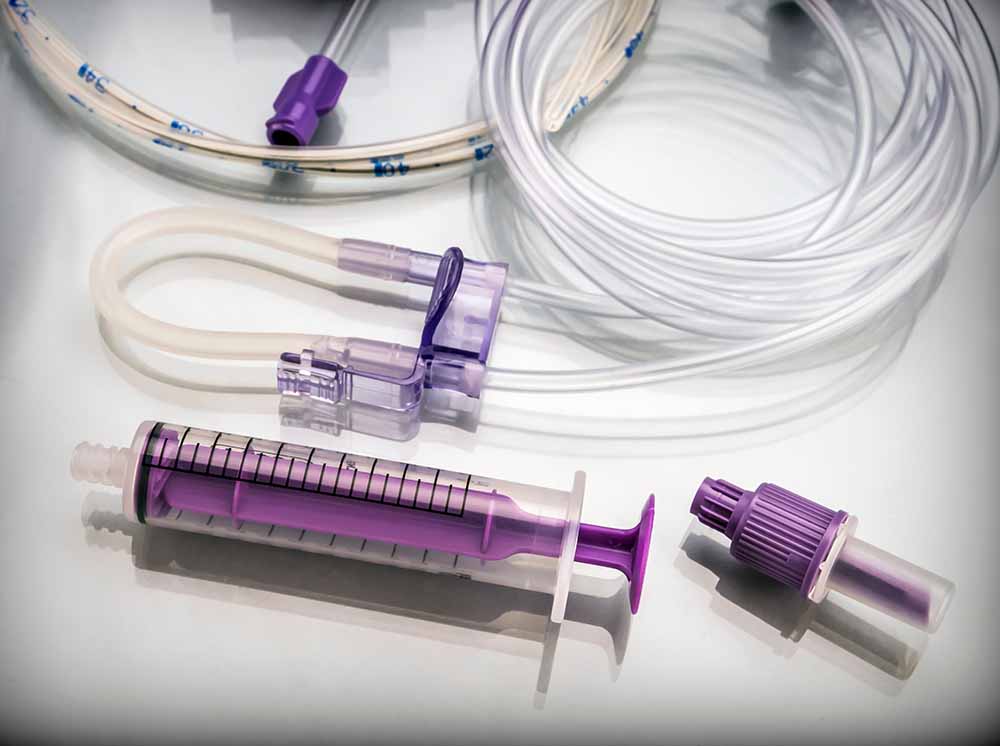
Syringe
- Pushes formula through the feeding tube
- Often used for intermittent feedings1
Gravity Bag
- The bag hangs above the patient, and gravity pulls the formula through the feeding tube
- Often used for intermittent feedings
- Very thick formulas may require adjustments to the feeding method or equipment1
Feeding Pump
- Delivers formula at an automated rate
- Sometimes used for continuous feedings
- Sometimes used for intermittent feedings1
Managing Feeding Schedules and Timing
Whether the patient has one caregiver or several, establishing a consistent enteral feeding schedule is key to success. Daily feeding routines may evolve. Caregivers may need to add or remove equipment as needs change.
Before beginning a feeding session, take time to check in with the patient. Depending on how the patient is feeling, this step may add several minutes to your routine.
Plan accordingly. It might help to have a distraction during the feeding session. Consider activities to keep the patient’s attention focused elsewhere while feeding.2
No matter the formula delivery method, always follow the guidelines your doctor gives you.
Push Feeding
- This delivery method may take up to 30 minutes.2
Gravity Feeding
- This method may take 20 minutes to an hour2
Pump-Assisted Feeding
- This method may also take several hours.1
Mobility and Movement During Daily Activities
Enteral feeding sessions can take anywhere from a few minutes to a few hours, depending on the delivery type. Meanwhile, daily life doesn’t slow down. Sometimes, the patient may have to move in the middle of a meal. Managing tubing length during mobility can support comfort when seated or during daily activities.
Be mindful of the tube site during routine tasks such as dressing, bathing, or repositioning. Secure connections with covers and other compatible accessories. This will help reduce the risk of leaks or disconnections.2
Many enteral feeding pumps include a backpack or carrying accessories for convenience and portability. With the right portable feeding equipment, patients can take their enteral feeding with them wherever they go throughout the day.
Managing Supplies Throughout the Day
Keep enteral feeding supplies organized and accessible. This will help manage home care storage inventory and help avoid interruptions caused by shipping delays, unexpected supply shortages, or chain delays.
Plan for feedings away from home by preparing portable feeding supplies ahead of time. Consider packing feeding kits in individual bags. This will help optimize storage space and help ensure equipment is ready to go wherever and whenever you are.
If you’re planning a trip, be sure to pack additional essentials such as:
- Formula
- Feeding pumps, tubes, sets, bags
- Sterile or distilled water (if instructed)
- Zip-top bags or empty containers
- Syringes
- Gloves
- Coolers and ice packs
Equipment Setup and Cleanup
Because of the many components, there is a bit of time involved in preparing and disconnecting reusable or disposable feeding systems. However, as you develop a routine, you will become more time-efficient.
Create a station that is comfortable for the patient during sessions. Consider setting apart an area solely for feeding. This will help reduce the time required to prepare for tube feedings.
Always wash your hands before touching enteral feeding equipment.
Examine the equipment each time before use. Regularly replace supplies as directed by your doctor to help ensure patient safety and feeding efficiency.2
Prepare supplies before you begin. This helps make the process as seamless as possible.
Preparing Supplies
Push Feeding
- Wash hands
- Gather formula, pour spout measuring cup, syringe, and water
- Wipe down the formula container
- Shake formula
- Pour formula into a measuring cup1
Pump Feeding
- Wash hands
- Gather pump, formula, syringe, pump set, pole or , and water
- Wipe down the formula container
- Shake formula
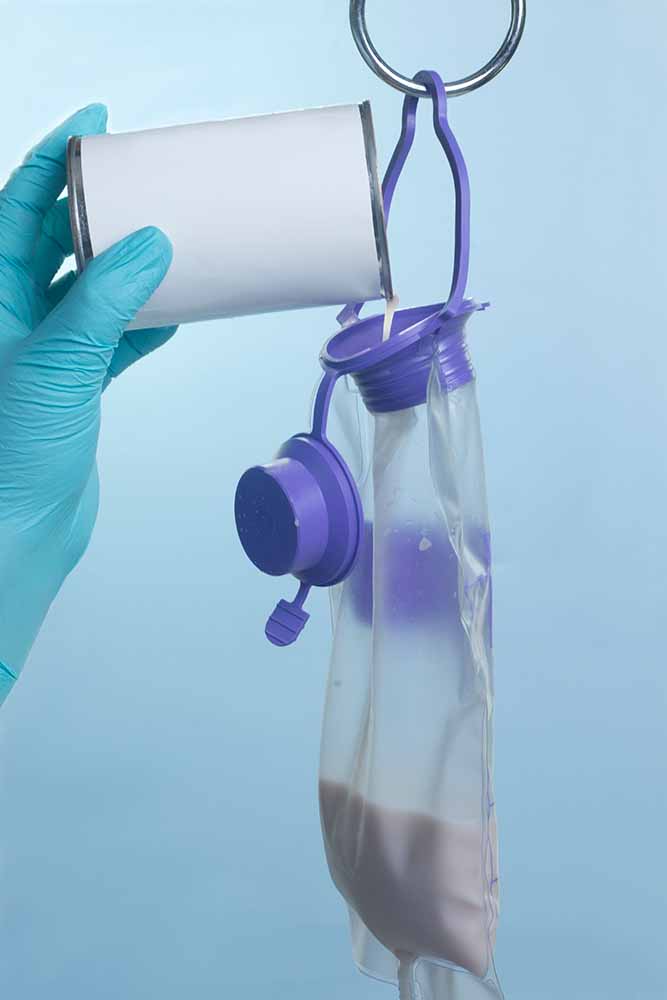
- Pour formula into the feeding container
- Position the feeding container above the pump
- Attach the feeding set to the pump1
Gravity Feeding
- Wash hands
- Gather a feeding bag, formula, syringe, gravity set, pole, and water
- Wipe down the formula container
- Mix the formula into the feeding bag
- Position the feeding bag above the patient’s stomach
- Attach the feeding set to the feeding bag
- Open flow regulator clamp
- Allow the formula to flow to 0.25 inches above the connector
- Close the flow regulator clamp
- Ensure the drip chamber is filled halfway1
Cleaning Up Supplies
Syringe Feeding
- Flush the feeding tube with water
- Wash and dry syringes after every use
- Replace syringes as often as your doctor recommends1
Pump Feeding
- Flush the feeding tube with water
- Rinse the feeding container every 8 hours
- Throw away any pre-filled formula 48 hours after opening
- Replace the feeding bag, tubing, and syringes according to the manufacturer's instructions and as often as your doctor recommends1
Gravity Feeding
- Flush the feeding tube with water
- Wash and dry the feeding container, tubing, and syringes after every use
- Throw away any pre-filled formula 48 hours after opening
- Replace the formula container, tubing, and syringes as often as your doctor recommends1
Managing Tubing and Connectors
ENFit® connectors are standard in most enteral feeding systems. ENFit connectors reduce the risk of tubing misconnections between enteral feeding systems and other medical devices such as IV equipment. This design secures the connection between feeding tube components, twisting and locking into place to reduce the risk of accidental disconnections and leaks.
While it is impossible to prevent every tubing issue, proper securement can help prevent accidental disconnections. It can also help deter younger patients from purposefully disconnecting the tubing.3
Examples include:
- Securement devices
- Medical tape4
- Abdominal binders
- ACE bandages
- Gauze
- Onesies3
When considering enteral feeding accessories, it is important to know which products work with which feeding system. Some items are universal while others are brand-specific. Always validate compatibility before purchasing equipment.
General Safety and Daily Use Considerations
Consistent maintenance and proper organization help improve the effectiveness, safety, and longevity of equipment. Always follow the manufacturer’s instructions while setting up, using, or cleaning enteral feeding components.
Formula Safety
- Follow your doctor and the manufacturer’s instructions
- Store opened formula in a zip-top bag in a cooler or fridge, or as directed by the manufacturer
- Discard leftover formula after the time specified by the manufacturer’s guidelines
Feeding Set Safety
- Stay aware of your surroundings and equipment
- Wash your hands before changing the feeding pump tubing
- Keep the enteral feeding station clean and sanitary
- Turn off the pump before cleaning
- Check that the tubing connection is tight after replacing any connectors
- Frequently clean and replace equipment
Conclusion
Caregiving for a patient with a feeding tube is a lot of work. Whether it’s creating a feeding schedule, troubleshooting tubing issues, cleaning equipment, or creating a safe space for feeding sessions, the list of to-dos may seem colossal.
Preparation, organization, and routine can help simplify these challenges. Follow the instructions and guidelines given to you by your doctor and the enteral feeding equipment manufacturers.
Always maintain access to essential enteral feeding supplies. Stock up on necessities in case of shortages or supply chain delays.
Practice patience and trust the process. In time, these challenges will seem less daunting as you acclimate to daily life with an enteral feeding tube.
Footnotes
- 1 “How-to’s & Education Continuous Tube Feeding | Nestlé Health Science USA.” Nestle.com, Nestle, www.nestlehealthscience.us/mytubefeeding/tube-feeding-education. Accessed 25 June 2026.
- 2 “Everyday Tips - Complex Care at Home for Children.” Complexcareathomeforchildren.com, Complex Care at Home for Children, complexcareathomeforchildren.com/enteral-nutrition/everyday-tips/?tab=7. Accessed 25 June 2026.
- 3 “Peg - g-Tube Home Care - Pediatric Gastroenterology, Hepatology & Nutrition - Golisano Children’s Hospital - Rochester NY - Urochester Medicine.” Urmc.Rochester.edu, University of Rochester Medicine Golisano Children’s, www.urmc.rochester.edu/childrens-hospital/gastroenterology/g-tube-home-care/peg. Accessed 25 June 2026.
- 4 “Securing and Waterproofing Your Child’s Feeding Tube – HY-Tape International, Inc..” Hytape.com, HY Tape International Inc., 31 Aug. 2020.

Login and Registration Form