
Quick Summary:
Enteral feeding pump alarms vary among different brands and manufacturers. This blog is a quick reference guide for caregivers about common feeding pump problems, the alarms that may trigger, and how to troubleshoot and resolve the issue.
Click a link to jump to the section.
Introduction
When caring for someone with an enteral feeding pump, you may encounter various problems while running the pump and administering feedings. Enteral feeding pumps have alarms to indicate when something may be wrong with the pump or feeding process.
Many alarms can be difficult to understand at a glance, and pumps may use different alarm names, symbols, codes, or lights to indicate a problem. This blog is a guide to common enteral feeding pump problems, the alarms you may see on your pump, and how to troubleshoot.
IMPORTANT NOTES:
1. Alarms and their wording vary among pump models. The potential alarms listed in this blog are real examples from various pump models but may not apply to your specific pump. Always check the user manual for specific alarm guidance and troubleshooting instructions.
2. Take note that pump alarms do not detect every complication that may arise during feeding. Stop the feed and ask for clinical help when appropriate if there is:
- A displaced or damaged feeding tube
- Significant abdominal pain or distention
- Repeated vomiting
- Suspected aspiration or difficulty breathing
- New bleeding
- Unresolved tube obstruction
Formula Stops Moving Through the Tubing
Potential alarms:
- NO FLOW IN
- NO FLOW OUT
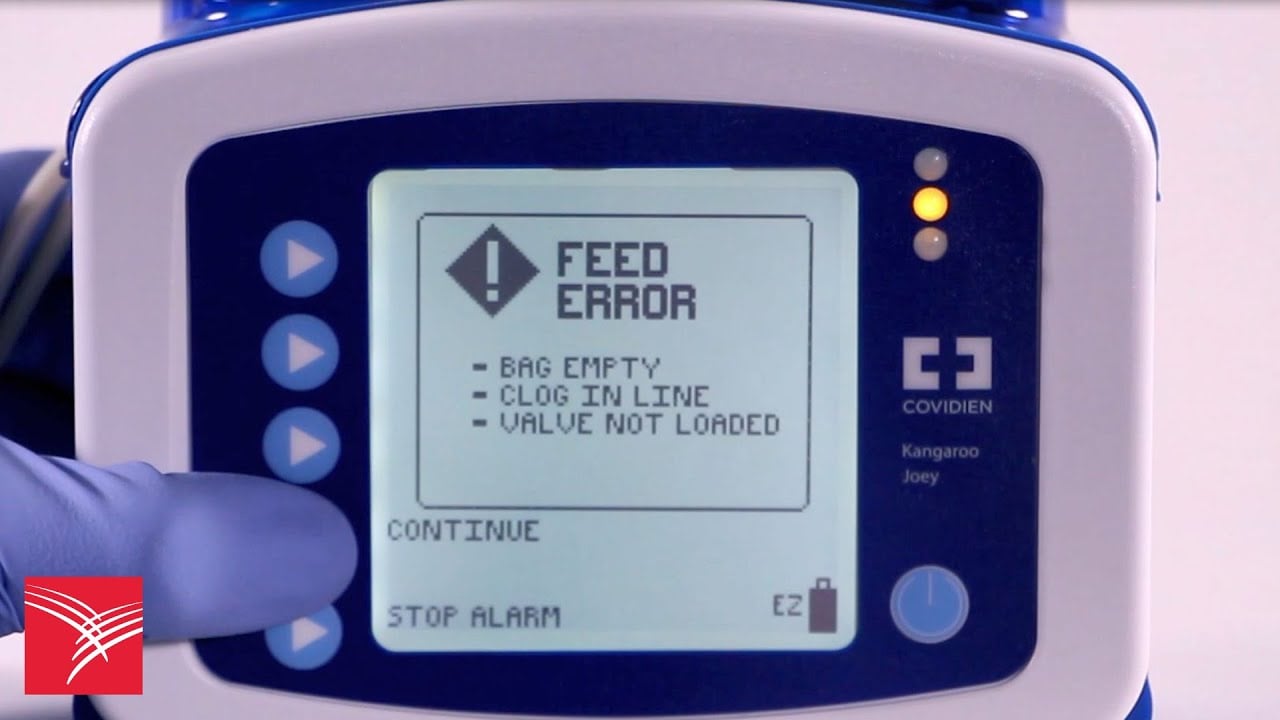
- Feed error
- Flow Error
- Patient Tube Blocked
- Occlusion In/Occlusion Out
The formula has stopped moving through the tubing, and the feeding has stopped. This often happens because there is an upstream blockage in the set between the pump and the bag (e.g., NO FLOW IN, OCC IN), or there is a downstream blockage in the set between the pump and the user (e.g., NO FLOW OUT, OCC OUT).
How this happens:
- Mixing medicine with formula
- Not thoroughly crushing medicine tablets
- Using time-release medicines in tubing
- Not flushing tubes properly or regularly
- Using formula or blenderized foods that are too thick or sticky for tubing
- Closed tube clamp
- Kinked tubing
How to troubleshoot:
- Check that the tube clamp is open and for any signs of kinked or twisted tubing.
- Check the tubing for any signs of blockages. Blockages often occur due to formula buildup and/or medications.
- If you find a blockage, try to clear it by "milking" the tube. Gently massage out the blockage by using your thumb and forefinger to help loosen or disperse the blockage.
- If manually pushing out the blockage doesn't work, try filling a 60 mL enteral syringe with warm water (follow the prescribed flush volume). Connect it to the tubing and push and pull the plunger to flush the tubing and dislodge the blockage. Use gentle pressure; never force fluid through a blocked tube.
- If the blockage still won't clear, try flushing the tubing with an enzyme-based declogging solution. Avoid using soda or other carbonated beverages to try to clear the blockage, as this can interact with formulas or medication and/or cause further clogging.
How to prevent this problem:
- Flush the feeding tube with warm water before and after each feed, and between separate medication administrations.
- Change feeding tubes regularly. Some tubing may need to be changed more regularly than others. Always check the manufacturer's recommended guidelines for replacing and changing tubing.
- Use formulas or liquids that are fully blended.
If you can't clear the alarms and feeding won't proceed after multiple troubleshooting attempts, consult the manufacturer's user manual for recommended next steps. You may also want to call the manufacturer directly for further help. Consult with your loved one's doctor about the problem and what they recommend next.
Air, Bubbles, or Foam Appear in the Tubing
Potential alarms:
- AIR IN LINE
- AIR
- Air in giving set
- NO FOOD
Your pump may alert you with the above examples, or you may see air bubbles or foam in feeding tubing.
Why this happens:
- Not priming or incomplete priming of the feeding set
- An empty or nearly empty feeding bag
- Excessive foam
- Air entering the feeding set
How to troubleshoot:
- Check the feeding bag for any food or formula. If it's empty, you can refill the bag and prime the feeding set to remove air from the bag and tubing.
- If there are visible air bubbles in the tubing, disconnect the feeding set from your loved one. Most enteral feeding pumps have an automated priming function. If this is the case for the pump your loved one is using, use it to prime until the air bubble moves to the end of the tubing.
- Make sure the cassette receptacle is clean.
- Check that the feeding set is properly loaded and the door is closed.
- Check for signs of worn tubing. If tubing is worn, replace it with a new set.
- Check the user manual. The pump manufacturer may have more specific guidance on how the pump can help clear air bubbles or foam.
How to prevent this problem:
- Let foamy formula settle for before administering. Blenderized or mixed formulas can foam from mixing. Some pump manufacturers may recommend letting the formula settle for about 10 to 15 minutes.
- Regularly prime feeding sets before using them.
The Pump Will Not Start After the Feeding Set Is Loaded
Potential alarms:
- LOAD SET
- Pump Set Dislodged
- Rotor Error
- Cassette Dislodged
- Cassette Error
- NO CASSETTE
- NO SET
- Re-insert giving set
- SHUT DOOR
- DOOR OPEN
- DOOR
You inserted the feeding set and initiated feeding, but the pump will not begin the feed.
Why this happens:
- Dislodged feeding set or feeding set that is not loaded properly
- The feeding set may not be compatible with the pump (incorrect brand or design)
- The pump door is not properly closed
- Tubing loaded incorrectly
How to troubleshoot:
- Check that the pump cassette is seated snugly in its receptacle. A compatible cassette should never have to be forced into place.
- Open the pump door and close it again, ensuring it is properly closed.
- Try removing and reinstalling the feeding set according to the manufacturer's instructions.
How to prevent this problem:
- Follow the manufacturer's instructions on how to properly install the feeding set. When a set fits properly, it should never have to be forced or jammed into place.
- Double-check that the feeding set is compatible with the pump.
The Pump Says the Feeding Is Finished Too Soon
Potential alarms:
- END OF THERAPY
- END OF DOSE
The pump has indicated the feeding is finished, but the delivered volume does not match the prescribed amount.
Why this happens:
- Some pumps track previously programmed feeding volume and may not have been updated correctly to match the new volume.
How to troubleshoot:
- Double-check the programmed volume and ensure it is the prescribed volume. If you are unsure how to check the programmed volume on the pump, consult the manufacturer's user manual for more guidance.
- When making any programming changes, always follow the care plan prescribed for your loved one by their doctor. If feeding stops prematurely and you are unsure how to make up the difference, speak with your loved one's doctor.
The Same Alarm Keeps Returning
If an alarm you have previously resolved keeps returning, that usually means the underlying cause has not been resolved, or the pump may need servicing or repair.
NOTE: Before assuming the pump needs servicing, investigate thoroughly and consult with your loved one's doctor. If a recurring blockage or flow alarm keeps alerting, it is more likely the underlying problem has not been identified yet.
How to troubleshoot:
- Check the manufacturer's user manual for guidance. Speak with customer support for specific advice concerning your pump, as online advice may vary and may not apply.
- Common causes of pump problems may include damaged or kinked feeding tubing, dirty sensors, or an improperly loaded feeding set. Thoroughly check every part of the pump, tubing, and feeding set to ensure everything is clean, undamaged, and properly installed.
- If you see an unfamiliar or hard-to-interpret system error or alarm, check the user manual for more guidance. Some pump errors can indicate something wrong with the pump's internal system (e.g., sensor errors, valve errors, etc.) and may need servicing or repair.
When to Stop Troubleshooting and Get Help
If you are experiencing consistent issues or alarms even after multiple troubleshooting attempts, consult with your loved one's care team for more guidance on how to resolve the problem and the next steps.
Final Notes:
- Do not clear or disable alarms to force the feeding to continue. Thoroughly investigate the problem and troubleshoot the issue until it is resolved.
- Do not force any pump components into place. All compatible parts should fit snugly into place without significant force.
- Do not make unfamiliar programming changes in an attempt to resolve a problem without consulting with your loved one's doctor.
- Do not attempt to substitute incompatible feeding sets.

Conclusion
Enteral feeding pumps are designed to indicate certain operating conditions, like flow interruptions, air in the feeding set, or pump errors. Common feeding problems may trigger different alarms among various feeding pumps. Being familiar with the pump, its specific warnings, and what those warnings mean is essential to your loved one's care.
Vitality Medical has a variety of enteral feeding supplies to complete your loved one's care. Shop our selection of enteral pumps, feeding sets, declogging solutions, and more, from trusted manufacturers.

Login and Registration Form